Waziristan, located along the Afghanistan-Pakistan borderlands, has long been a major epicentre of insurgency and violence. New research indicates that open warfare and insurgent violence have evolved into more dispersed and less overt forms embedded in everyday life.
Keywords: Waziristan, Pakistan, Afghanistan, borderlands, conflict transformation
Once described as the most dangerous place on earth, Waziristan* is a tribal borderland in northwestern Pakistan that occupies a central yet deeply paradoxical position in regional security and geopolitics.
Its rugged mountains and porous border with Afghanistan have long enabled militant groups to evade Pakistani and international security forces. Following the 9/11 attacks and the United States-led invasion of Afghanistan in 2001, Waziristan became a sanctuary for Al-Qaeda and other foreign militant groups fleeing across the border. In following years, it became one of the principal strongholds of the Pakistani insurgent group Tehreek-e-Taliban Pakistan (TTP), formed in 2007. The Afghan Taliban’s return to power in Afghanistan in 2021 further reshaped the regional balance of power and reconfigured the conflict dynamics of the Afghan-Pakistan borderlands.
In Waziristan, patterns of violence have consequently shifted from large-scale insurgency and open warfare to more dispersed and adaptive forms embedded within everyday life, such as targeted killings, attacks on security infrastructure, cross-border militancy, digitalisation of insurgency, and the gradual shrinking of civic space.
About this research
The analysis presented in this article combines existing research and security assessments with original qualitative evidence collected as part of a broader doctoral research project at the University of Melbourne. It draws on 37 semi-structured interviews conducted between January and December 2024. Participants included residents, students, civil society activists, community leaders, military and government officials, and other local stakeholders from Waziristan. Owing to security concerns and institutional risk management requirements, fieldwork was conducted outside Waziristan using a combination of in-person and online** interviews. The majority of in-person interviews were conducted in Peshawar and Islamabad, where participants from North and South Waziristan were accessible. All participants provided informed consent, and identifying details have been withheld to protect their anonymity and safety. Interview data were analysed thematically and triangulated with existing literature and security assessments to produce a grounded analysis of the evolving conflict dynamics in Waziristan.
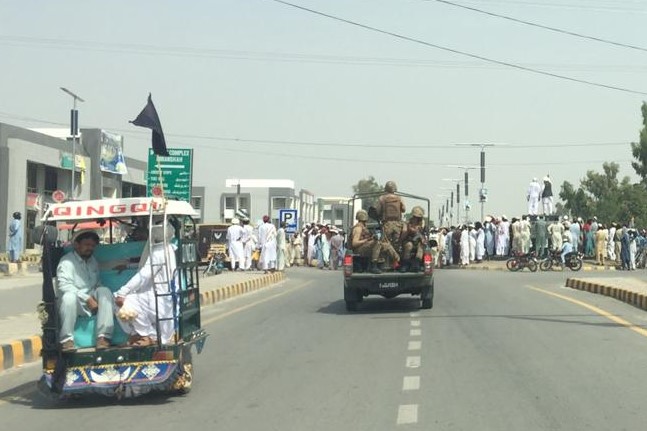
Public protest in Miranshah, North Waziristan (August 2019), with a military security escort accompanying the research team’s vehicle. Credit: Author.
Insurgency in Waziristan following the US ‘War on Terror’
The emergence and persistence of militancy in Waziristan are rooted in decades of exceptional governance and political exclusion, regional geopolitical dynamics, and successive cycles of armed conflict. Under British colonial rule from 1858, Waziristan was governed through the Frontier Crimes Regulation, an exceptional legal framework that limited state integration while preserving indirect tribal governance. Following Pakistan’s independence in 1947, this governance framework remained in force across the Federally Administered Tribal Areas (FATA), perpetuating political exclusion and limiting the expansion of formal state institutions. It remained in effect until 2018, when FATA was merged with the province of Khyber Pakhtunkhwa.
The origins of organised militancy, however, can be traced to the Soviet-Afghan War (1979-1989), when Pakistan, supported by the US, facilitated the mobilisation and training of Afghan Mujahideen through the tribal belt in Northwestern Pakistan. Waziristan’s rugged terrain, porous border with Afghanistan, and limited state presence facilitated the establishment of militant networks, with their organisational infrastructure and ideological influence enduring well beyond the Soviet-Afghan War. The 9/11 attacks on the US in 2001 and the subsequent US-led invasion of Afghanistan transformed the region into a sanctuary for fleeing Taliban and Al-Qaeda fighters, creating the conditions for the formation and consolidation of the TTP in 2007.
Established as an umbrella organisation, the TTP unified Pakistani militant factions to establish Islamic rule and wage an insurgency against the Pakistani state. Over time, the TTP established parallel systems of governance, challenged both tribal and state authority, and transformed Waziristan into the epicentre of Pakistan’s insurgency. In response to the growing threat of militancy, the Pakistani state launched extensive military campaigns, culminating in major operations such as Zarb-e-Azb in 2014, to dismantle militant infrastructures and restore territorial control across North and South Waziristan.
The relative decline in large-scale militant violence that followed enabled the gradual return of displaced populations, alongside an expanded role for state institutions, particularly security institutions, in managing processes of recovery and stabilisation across the region. However, while the expanding state control and military operations significantly reduced overt insurgent violence, they did not fully dismantle the broader conditions sustaining insecurity.
The Taliban takeover of Kabul in 2021 and the resurgence of militancy
The Taliban’s return to power in Afghanistan in August 2021 significantly reshaped the conflict environment across Pakistan’s northwestern borderlands. The rapid escalation of militant activity became visible almost immediately, with the TTP claiming 32 attacks in August 2021, 37 in September, and 45 attacks by December of the same year. Pakistan’s initial response to the Taliban’s return was shaped in part by geopolitical considerations, yet security studies scholar Zahid Shahab Ahmed stresses that the development simultaneously accelerated the resurgence of the TTP and intensified domestic militancy.
A former student leader from North Waziristan critically reflected that:
‘The return of instability can be attributed to several factors. One major issue is the border with Afghanistan. As long as there is unrest in Afghanistan, it naturally affects us because of our shared border. It is a large, porous border, and people continue to cross it, leading to problems like target killings and rising violence’ (personal communication, 20 February, 2024).
Peace and conflict scholar Anders Themnér’s work ‘Violence in Post Conflict Societies’ provides an important analytical lens. Themnér argues that remobilisation is not simply the automatic outcome of structural grievances or institutional fragility, but a relational process sustained through networks connecting elites, intermediaries, local brokers, and armed actors. From this perspective, the resurgence of militancy in Waziristan can be understood through the reactivation of cross-border militant relationships and social networks that survived beneath the surface even during periods of relative stabilisation. This became visible almost immediately after the Taliban takeover. Thousands of imprisoned militants, including TTP members, were reportedly released from Afghan prisons as the Afghan state collapsed. Locals (research participants) also repeatedly noted that violence intensified after 2021 and that militant networks began reappearing in local areas. The border, despite fencing and intensified securitisation, was a fluid and contested space through which fighters, weapons, networks, and relationships move and reorganise.
Importantly, the Taliban’s return also carried symbolic significance that extended far beyond immediate military realities. For militant organisations operating in Pakistan, the fall of Kabul reinforced the ideological belief that prolonged armed insurgency can ultimately challenge and overcome state authority. It also reinforced the symbolic appeal of insurgent narratives across sections of the borderlands, particularly as the TTP openly viewed the Afghan Taliban’s victory as a model for militant struggle and political authority in Pakistan. The resurgence of militancy was therefore not only organisational and operational, but also symbolic and relational, rooted in the reactivation of networks and identities that continued to connect Waziristan to the wider conflict dynamics unfolding across the Afghan-Pakistan borderlands.
From open conflict to dispersed violence
One of the most striking transformations in Waziristan since 2021 has been the shift from visible insurgency toward far more intimate and dispersed forms of violence. During the peak years of conflict, violence was largely associated with bomb blasts, territorial occupation, attacks on military convoys, and direct confrontations between militants and the state.
The contemporary landscape of fear is now shaped predominantly by targeted killings. Research participants noted that almost every week, mainstream and social media report the killings of tribal elders, teachers, truck drivers, journalists, police, local politicians and activists being shot dead, often in circumstances marked by ambiguity and silence. People do not know who carried out an attack, why particular individuals were targeted, or who may be next. Reflecting on this pattern, a university student from North Waziristan remarked:
This situation has taken a considerable psychological toll on me. Social media pages from Waziristan often feature posts about individuals shot and killed in Miranshah, with many remaining unidentified. Unless follow-up news is shared, I find myself worried and anxious, fearing that the victim might be a family member. Additionally, it is difficult to contact my family regularly due to network and internet issues. We don’t know who is responsible for the killings and the reasons behind them (personal communication, 19 February, 2024).
As sustained territorial control became increasingly difficult under intensified military surveillance and security operations, militant networks adapted through decentralised and mobile forms of violence designed to generate psychological impact disproportionate to their scale. This adaptive logic resembles what scholars Shahzad Akhtar and Zahid Shahab Ahmed explain as the resurgence dynamics of the TTP after 2021, where militant groups reorganised through leadership consolidation, external sanctuary, strategic mobility, and cross-border operational flexibility. Violence thus became more fragmented yet simultaneously embedded in everyday social life.
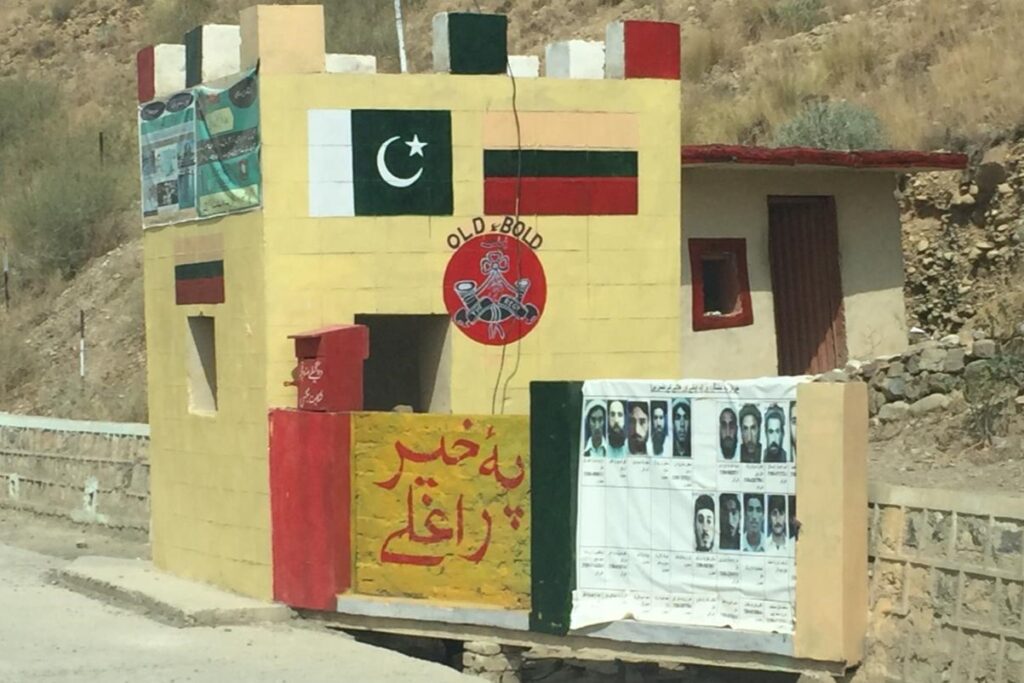
Military checkpoint along a road in North Waziristan. The red sign reads Welcome in Pashto, and wanted militant posters are displayed beside it (August/2019). Credit: Author.
Attacks on checkpoints
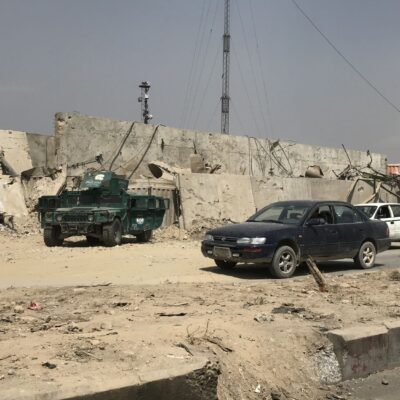
The pervasive presence of checkpoints is one of the clearest expressions of militarised governance in Waziristan. Designed to monitor movement and enhance security, checkpoints operated by state security forces are dispersed across roads, village entrances, markets, and intersections in the form of roadblocks, snap checkpoints, and fortified military posts. Attacks on checkpoints and security personnel continue with unsettling regularity, generating widespread public frustration and deepening scepticism regarding the effectiveness of prevailing security arrangements.
A report by the Pakistan Institute for Conflict and Security Studies notes that militant groups progressively adopted tactics involving ‘roadblocks and snap checkpoints,’ reflecting not only operational recovery but attempts to symbolically challenge state authority across vulnerable frontier regions. Direct and coordinated guerrilla-style attacks, mainly on security forces but also civilians, became the deadliest form of militant violence in 2024, as tribal regions including Waziristan witnessed a 17 percent rise in such attacks alongside a 98 percent increase in fatalities.
Local narratives repeatedly reflected this contradiction, questioning how targeted killings and militant attacks could persist despite the extensive presence of checkpoints. Such accounts reveal a deeper tension within the contemporary security landscape of Waziristan. Structures intended to ensure security have increasingly become intertwined with experiences of anxiety and insecurity.
Border clashes and the frontier as a space of permanent instability
The intensification of border clashes following the Taliban’s takeover of Kabul has transformed the Pakistan-Afghanistan frontier from a contested boundary into a chronically volatile conflict geography. Between 1 January and 28 November 2025 alone, the Armed Conflict Location & Event Data Project (ACLED recorded more than 80 border clashes between Afghanistan and Pakistan, more than double the number documented in 2024.
The resurgence of the TTP now constitutes the central fault line shaping relations between Islamabad and Kabul, with recurring armed confrontations increasingly collapsing the distinction between domestic insecurity and regional conflict. The porous nature of the Pakistan-Afghanistan border enables militant groups to retreat, regroup, and operate across territorial boundaries. Waziristan is not merely a peripheral border region but a critical node within an interconnected regional conflict system where local insecurity is continually reproduced through the unresolved tensions and escalating militarisation.
Targeting peace activists and the shrinking of civic space
Perhaps one of the most disturbing transformations of violence in Waziristan has been the increasing targeting of peace advocates, youth activists, and community organisers. Unlike earlier phases of conflict centred largely on open military confrontation, contemporary violence increasingly seeks to silence voices demanding peace and accountability. Several respondents observed that those speaking publicly for peace often become among the most vulnerable. Local narratives repeatedly referenced the killing of four members of the Youth of Waziristan organisation in June 2022, who advocated for human rights and peace in North Waziristan, and who were shot dead by unidentified gunmen. This shift reflects a deeper transformation of violence where the suppression of civic space itself has increasingly become part of the conflict landscape.
Analysis of targeted killings in North Waziristan by peace and conflict studies researcher Faryal Khan demonstrates that such violence has increasingly focused on educated youth, local activists, tribal elders, and individuals openly denouncing militancy. Among the cases examined in her analysis are the July 2022 assassinations of Qari Nauman and Qari Samiuddin in North Waziristan. As vocal opponents of militant violence, their killings highlight the growing use of targeted assassinations to silence civic dissent.
The digitalisation of insurgency
A defining feature of the evolving violence in Waziristan is the growing fusion of militancy with digital and technological infrastructures. TTP and affiliated groups increasingly rely on encrypted communication platforms, artificial intelligence tools, social media networks, and commercially available drones to expand both their operational and ideological reach. The TTP has also strengthened its digital warfare through AI-generated propaganda, multilingual social media campaigns, and encrypted Telegram and WhatsApp networks designed to circulate militant narratives and legitimise violence across borderland communities.
The growing use of drones and laser gun attacks, in particular, reflects a significant transformation in the operational logic of militancy. In May 2025, a suspected drone strike in Mir Ali, North Waziristan, reportedly killed four children and injured several others, Local suspicions initially focused on state security forces, but Pakistani authorities accused the TTP of carrying out the attack.
The Afghan Taliban has profoundly reshaped the regional balance of power and the security dynamics of the borderlands
In Waziristan, violence has consequently evolved beyond the visible landscapes of insurgency and open warfare into more dispersed, adaptive, and less visible forms that continue to permeate everyday life. As a strategically significant borderland, Waziristan reveals that local insecurity is intertwined with wider regional geopolitical transformations. Rather than serving as a peripheral space, it remains a critical frontier where cross-border networks and militarised governance continually reshape the contours of violence. Recognising these interconnected borderland dynamics is essential for moving beyond conventional understandings of security centred on battlefield violence and towards a more nuanced account of how insecurity is sustained and transformed across borderlands.
*The Waziristan region presently comprises three administrative units: North Waziristan, South Waziristan Upper, and South Waziristan Lower. For analytical clarity, this article collectively refers to all three units as Waziristan.
** Where in-person interviews were not feasible, interviews were conducted via Zoom and WhatsApp calls.
Main image: Travelling to a mining site along a dirt road in North Waziristan under military security escort. August/2019. Credit: Author.