After staging a coup in 2021, the Myanmar military constructed a highly controlled electoral process that did not include genuine electoral choice but enabled the military to establish a claim to political authority in the language of democracy.
Key words: Myanmar, political legitimacy, military, elections
Elections are commonly understood as an essential element of political legitimacy for governments in democracies.
But authoritarian regimes hold elections too, while restricting competition and strategically manipulating the process. More puzzling is their persistence under closed authoritarian rule, where rulers have little intention of allowing voters to determine who governs. Why, then, do authoritarian rulers invest in elections?
Myanmar’s military
Few cases illustrate this paradox as starkly as contemporary Myanmar. On 1 February 2021, the military prevented the formation of an elected government after refusing to accept the result of the November 2020 general election. The election had confirmed the National League for Democracy under Daw Aung San Suu Kyi with an overwhelming majority. The military tried to justify the coup with allegations of electoral fraud that were never substantiated. Yet elections did not disappear from the military’s political agenda. On the contrary, the promise of fresh elections was essential for the coup rhetoric from its beginning, and the military subsequently invested years of administrative, political and coercive effort in preparing polls of its own. In December 2025 and January 2026, amid continuing armed conflict and political resistance, it finally staged them.
The military-organised elections lacked fundamental conditions associated with meaningful democratic choice, including fairness, inclusivity, genuine political competition and public trust. Yet to dismiss them simply as meaningless elections would overlook the political work that these polls were intended to perform. The military sought to demonstrate its capacity to impose a political process on its own terms. Staging elections amid ongoing conflict and territorial fragmentation was itself a performance of power, intended to make visible the military’s continued control over political institutions and the electoral process.
The performance of elections was central to the military’s attempts at political legitimation despite the absence of a genuine electoral mandate, for domestic as well as external audiences. This does not mean that the electoral process, or the political order it produced, thereby became legitimate. Rather, electoral legitimation helps explain why the military repeatedly returns to elections; and why an electoral process remained indispensable to its attempt to reconstruct political order after a military interregnum.
Authoritarian elections and political legitimation
A substantial literature on electoral authoritarianism has shown that manipulated or controlled elections can perform important political functions. They can help rulers manage elites, engineer succession, distribute political office, co-opt or divide opponents, mobilise supporters, and demonstrate organisational capacity and popular backing. Elections may thus strengthen authoritarian rule rather than undermine it. At the same time, their effects are contingent. Once an electoral arena exists, opposition actors may use it for purposes of their own, introducing political uncertainty that rulers cannot always contain. Participation in authoritarian elections creates a ‘democrat’s dilemma’—opposition voters may inadvertently bolster authoritarian rulers’ claims to legitimacy while simultaneously preserving opportunities for political contestation. This contingency has informed arguments about ‘democratisation by elections’ as well as the emphasis of political scientist Andreas Schedler on uncertainty and the potentially regime-sustaining and regime-subverting consequences of authoritarian elections.
This points to a seemingly paradoxical function of authoritarian elections: political legitimation. Legitimacy and legitimation are related but distinct. Legitimacy concerns whether political authority is regarded as rightful and justifiable against prevailing norms and values. Legitimation describes the processes and practices through which political actors seek to establish, maintain, or strengthen claims to legitimacy. A regime does not therefore need to possess democratic legitimacy to invest heavily in its legitimation. Electoral authoritarian regimes may make such claims through ostensibly adequate procedures, mimicking democratic forms without necessarily reproducing their democratic substance. In Myanmar, this mimicry extended to the construction and performance of an entire electoral process.
Elections are particularly powerful instruments of legitimation because they mimic popular consent as a normative basis of political authority, even where meaningful electoral choice is constrained or absent. Their legitimating function may be directed towards citizens and political actors at home, regime elites and state institutions, neighbouring governments and international actors. The relevant question is not only how legitimate an electoral process is, but what claims to legitimacy its performance enables a regime to make, to whom, and with what political effects.
Myanmar presents a particularly revealing case. The military overturned the results of the 2020 elections, but not without promising another election as the means through which constitutional government would be restored. The election was thus conceived as a transitional act: to move once again from direct military rule towards an ostensibly electoral and constitutional order. This was not an entirely new script. Myanmar’s military had attempted—and, in important respects, succeeded in—such a transition before, through the tightly controlled elections of 2010.
From 2010 to the 2021 coup: The return of an electoral script
The precedent for the military’s post-coup electoral strategy lies in the elections of 2010. Held under the military-drafted 2008 Constitution, with Aung San Suu Kyi under house arrest and the National League for Democracy absent, the tightly controlled polls were widely dismissed as a sham designed to perpetuate military rule in civilian guise. Yet their consequences proved considerably more substantial—and surprising. The elections enabled an engineered succession, constituted a new parliament and brought to office a nominally civilian government under President Thein Sein. More unexpectedly, they became the starting point for a political opening and reform process that gradually acquired credibility among domestic and international audiences. An election offering little meaningful electoral choice had nevertheless performed important political work and set political change in motion.
Five years later, the National League for Democracy contested a substantially more open and competitive general election and won overwhelmingly. Crucially, the military accepted the result. While retaining the extensive powers guaranteed to it under the 2008 Constitution, it allowed the electoral outcome to translate into a transfer of governmental authority. What had begun in 2010 as a tightly controlled transition had thus produced an electoral contest whose outcome was neither manufactured nor ultimately determined by the military.
The political order that followed remained constrained by the military’s constitutional powers and was marked by continued armed conflict and the persecution of the Rohingya which propelled Myanmar once more into the orbit of international condemnation, this time with Aung San Suu Kyi under criticism. However, the 2020 election results overwhelmingly confirmed her party in office and demonstrated the people’s choice against military rule. Once more, the military and its political allies had badly underestimated the electoral strength of the National League for Democracy, but unlike in 2015 did not accept the outcome.
The military aborted the electoral game, but it did not abandon elections. It staged a coup on 1 February 2021, prevented the new legislature from convening, detained the country’s elected leaders and seized power, justifying its intervention through allegations of electoral fraud. The promise of another election formed part of the legitimation narrative for the coup from the outset. The military pursued two seemingly contradictory projects: it ruled through emergency powers and brutal coercion, while continuing to invoke elections as the route through which constitutional government would be restored. Yet it now faced armed revolution, territorial fragmentation, profound domestic resistance and renewed sanctions. The military sought to make the electoral script work again, reproducing the institutional and legitimating effects of the earlier transition while containing the uncertainty that had followed it—without allowing the election to determine the political outcome.
The ‘menu of manipulation’ and electoral theatre for the 2025-2026 election
The electoral theatre of 2025-2026 was years in the making. From the first days after the coup, a military-appointed Union Election Commission revised voter lists, reshaped election administration, introduced new political-party registration and electoral rules, and instrumentalised the security conditions under which the vote would take place to essentially gerrymander electoral outcomes. The administrative and legal manufacturing took place while the military was simultaneously waging a brutal war against the population. These measures formed part of an entire menu of electoral manipulation extending across the electoral cycle, including oppression of the political opposition and co-optation of smaller political parties, the holding of the election in a limited territory of the country, and little voter buy-in. Much of the five-year interregnum was devoted to constructing the electoral arena in which the announced return to a government in civilian clothes was to be performed.
Particular attention was given to electoral system change. The military-appointed election commission revived longstanding discussions about proportional representation and spent years discussing a new model. Yet constitutional constraints meant that the eventual arrangement retained first-past-the-post for the lower house while introducing a hybrid system for the upper house, amounting to a less significant change than years of deliberation had suggested. However, the changes appeared above all designed to maximise the electoral gains of the military proxy party, the Union Solidarity and Development Party.
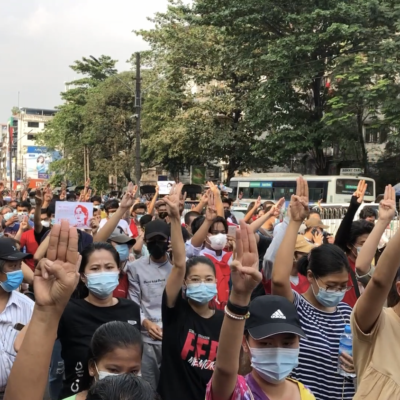
The field of political competition had, meanwhile, been radically transformed. The National League for Democracy was removed from the electoral arena: its leaders were imprisoned, its organisation severely repressed, and the party eventually dissolved after refusing to register under the military’s new political party law. The National Unity Government, formed on the basis of the 2020 election results in opposition to military rule, and much of the resistance rejected the electoral framework altogether. What remained was a field dominated by the Union Solidarity and Development Party and other military-aligned parties, alongside smaller and ethnic parties and individual actors who hoped to make political gains from limited participation. Political competition had not disappeared altogether but had been reduced to a semblance of competition within an arena constructed on the military’s terms.
Staging an election across a country at war presented another challenge. The military no longer controlled substantial parts of Myanmar and therefore let voting take place in phases, and only where it held sufficient territorial control. The resulting electoral map reflected the fragmented geography of military rule and its contestation. Meanwhile, preparations proceeded alongside military offensives and continued airstrikes. Ballots and bombs thus became part of the same political landscape: electoral preparations suggesting a return to normalcy unfolded alongside a war demonstrating precisely how far Myanmar remained from it. The question was not whether the polls met conventional democratic standards, but how much territory, participation and procedure were minimally necessary for the process still to be presented as an election. The very act of conducting polls under such conditions became a demonstration of the military’s capacity to exercise power.
Voting was conducted in three phases between December 2025 and January 2026. According to ANFREL and the Special Advisory Council for Myanmar, polling covered only 42 per cent of the country’s territory. The electorate was further narrowed through constituency cancellations, displacement, and restrictive voter registration. Even within this reduced electoral arena, participation remained contested. Reports of intimidation, coerced participation and irregularities in advance voting further complicated the meaning of turnout figures provided by the military, which are part of the legitimation performance itself rather than a measure of public engagement. According to the military’s own figures, approximately 13.14 million people voted, fewer than half the number who participated in the 2020 elections. Electoral manipulation thus extended beyond determining who could compete and where voting could occur to the production and presentation of participation itself. The reported turnout became another element of the legitimation performance, invoked as evidence of electoral success.
The extensive menu of manipulation alone does not explain why the military needed an election. If securing a predetermined outcome had been the only objective, much of this elaborate machinery would have been unnecessary. For the electoral performance to work, it required actors and audiences who resided also within the military itself. Political scientist Rodney Barker’s notion of self-legitimation is useful here: rulers engage in legitimating practices partly to confirm their own identities and claims to rightful authority. In Myanmar, this intersects with the Tatmadaw’s understanding of itself as agent of state-building and guardian of the political order. The 2008 Constitution had established a system in which the military could relinquish direct rule while retaining substantial power within a formally civilian government. Seen from within this logic, the 2021 coup was a correction, not an abandonment of that constitutional course, and another election was necessary to complete it.
Performing the new reality: actors, audiences and political effects
The political outcome of the electoral performance also depended on its external reception. Responses were sharply divided, but not politically equivalent. Some foreign actors supported the process and were ready to engage with the institutions and officeholders it brought about; others rejected the election and its associated claims from the outset. However, universal international approval was never necessary for the strategy to become effective. Beyond its enactment through the military apparatus, the performance needed some powerful actors outside the country who were prepared to engage with the political order it sought to produce.
The staging of international election observation became a particularly visible element in the wider electoral theatre. Myanmar’s Union Election Commission invited selected foreign observers and visitors, organised their access to the polls, and gave considerable prominence to their assessments. They came overwhelmingly from countries that either do not hold genuinely competitive multiparty elections or have themselves accumulated experience with authoritarian electoral practices. Election commissioners, politicians and party representatives, diplomats and other invited actors were presented collectively as international witnesses. Their assessments were reported as affirmative in state media: Russian observers described a ‘high-standard, transparent, and well-conducted election’, while a Cambodian election commissioner reported that voters participated ‘freely, without any interference, fear, or intimidation.’
This illustrates what Maria Debre and Lee Morgenbesser have called ‘mock compliance’: authoritarian actors reproduce the practice and language of international election observation while dispensing with the international standards and democratic values that provide it with normative meaning. The observers were therefore not simply an audience but were themselves staged as part of the electoral process, providing external testimony to precisely those qualities—freedom, fairness, transparency and popular participation—that were lacking. If sufficiently accepted, such mock compliance may contribute to hollowing out the standards being mimicked, with consequences for what could become presentable as a minimally acceptable election elsewhere, and for the viability of such blunt electoral legitimation as a strategy.
The immediate institutional consequence was to allow the military to move on from the post-coup interregnum. The elections reconstituted the Pyidaungsu Hluttaw, overwhelmingly dominated by representatives of the military-backed Union Solidarity and Development Party alongside constitutionally reserved military seats, and provided the institutional basis for the new government. They enabled General Min Aung Hlaing to realise his long-standing ambition of becoming president while facilitating a managed redistribution of offices among trusted military figures across the executive and legislature in line with the 2008 Constitution. The electoral process thus produced precisely the institutional transformation for which years of preparation had laid the ground, deliberately reorganising power around the presidency and preserving Min Aung Hlaing’s authority over the military.
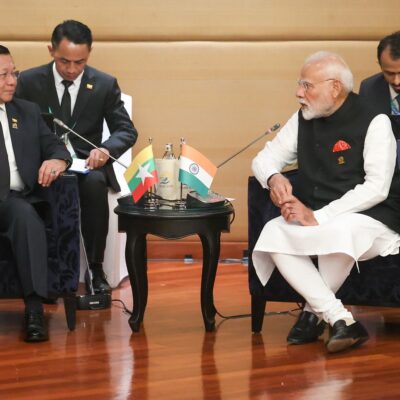
The significance of this outcome becomes yet clearer in the responses it elicited. India, China and Russia quickly welcomed the elections, congratulated Min Aung Hlaing on becoming president and invited him to inaugural visits as head of state. Thailand engaged the newly appointed Commander-in-Chief on security cooperation before inviting Min Aung Hlaing. Also Malaysia chose to work towards Myanmar’s full integration and others may follow while some ASEAN member states continue to reject the election’s legitimacy and resist normalisation, perpetuating the regional organisation’s long-standing problem of how to deal with its most rogue member state. The electoral theatre has not convinced its critics from the United Nations, European Union, Australia or other Western countries, but perhaps that was not necessary. Having performed an election on its own terms, the military had brought about a new institutional order with which sufficiently consequential external actors are prepared to engage, while others still have to position themselves towards it. The electoral legitimation strategy has altered the institutional and diplomatic terrain on which competing claims to legitimacy continue to be contested.
Conclusion: The perverse paradox of polls
Myanmar’s post-coup elections help explain why elections remain politically consequential even when they are not seen as legitimate. Their performance served to make the military’s power visible: its ability to dictate the rules, mobilise state institutions, and produce a political outcome despite the continuing contestation of its authority. The military did not stage elections to submit political authority to popular choice, but to perform other political work. The distinction between legitimacy and legitimation is therefore crucial. An electoral process may fail almost every meaningful democratic test and still become an instrument through which rulers establish claims to political authority in the language of democracy.
This is what makes Myanmar’s polls particularly perverse. The military refused to accept an electoral outcome, staged a coup, and waged a brutal war on its people while claiming that its intervention was necessary to protect democracy and constitutional order. It then spent five years constructing another electoral process whose political outcome could be better controlled. This performance encompassed far more than voting: it included the laws, institutions and administrative preparations preceding the polls, the management of parties and candidates, the staging of participation and international observation, and ultimately the reconstitution of parliament and government. Having hollowed out and destroyed the basis for genuine electoral choice, the military appropriated the grammar of elections in pursuit of political legitimation through an exercise of power.
Much points to the success of the deceptive drama so far. This political effectiveness does not make either the process or its consequences legitimate. The normative implications extend beyond condemning the elections as illegitimate or pragmatically accepting the political order they have produced. The capacity to stage elections and impose an institutional outcome does not establish a right to rule, just as the absence of democratic legitimacy does not render the resulting institutions politically inconsequential. This poses a dilemma for domestic and international actors alike and points to future research.
The international response exposes how little repertoire beyond condemnation and sanctions is available to international actors committed to democratic norms when confronted with such a persistent performance. Yet the experience of 2010—the very experience the contemporary military elite sought to replicate—shows that even authoritarian elections in Myanmar can produce consequences beyond those intended by their architects. The carefully controlled election of 2010 eventually opened a political and electoral arena in which uncertainty increased over time. The 2025-2026 process was constructed precisely to contain such uncertainty, yet how much uncertainty it has also managed to remove from what follows is too early to tell.
Image: A voter and official at a polling booth in Myanmar, December 2025. Credit: Myanmar Now/Wiki Commons.