Myanmar has been in turmoil since the military coup in 2021. How can a governing body with political ‘legitimacy’ be established through which the people may flourish?
Keywords: Myanmar, political legitimacy, democracy, federalism, military.
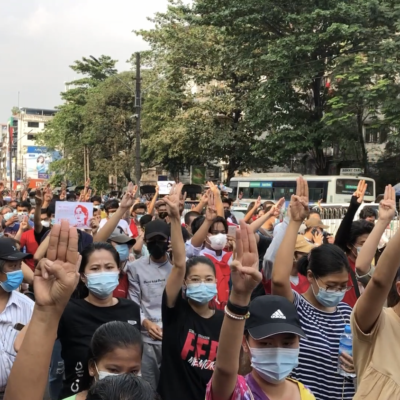
Myanmar’s troubled political history is again at a state of turmoil. A military-led ‘transition to democracy’ was abruptly halted in February 2021 when the military launched a coup, preventing the newly elected parliament from convening and arresting political parties and other democratic forces.
In the face of widespread civil and armed resistance, the military has since acted to strengthen its still-tenuous grip on power through violence and coercion, and, in 2025-2026, a ‘stage-managed’ general election. However, large tracts of Myanmar remain in dispute or governed by a variety of non-state actors, including ethnic armed organisations and longstanding political institutions.
Who governs, in these situations, may seem to relate more to the crudest ‘realist’ considerations—who has material control and can enforce compliance—rather than appeal or conformity to an ideal of legitimacy. Or if any political value of legitimacy is at stake, it may appear confined to conferring the right to govern on those with the ability to establish order and provide security for their subjects.
So why would we convene a special edition on political legitimacy in Myanmar? Does it really make a difference to who gets to govern and how, or reflect any important political value in this context? This was a question prompting much discussion among contributors to this volume, along with some scepticism. Nick Cheesman, for example, questions the utility of legitimacy as a concept—arguing the Myanmar military regime does not face a legitimacy crisis, but rather a compliance crisis. Other contributors entertain the legitimacy concept but highlight (e.g. Gladys Maung Maung) the limits of what it can explain or justify when construed one-dimensionally: whether as a non-coercive instrument of political control and compliance; or as a measure of sociological acceptance of political rule; or as an evaluation of the acceptability of this rule based on the application of some stipulated normative standards
A non-coercive instrument of political control
Understood first as a non-coercive instrument of political control, the significance of legitimacy is limited by recognition that, in the Myanmar context, legitimacy claims appear to follow control. Legitimacy is gained through the exercise of actions, such as taxation, that would normally be dependent on pre-existing legitimacy. Conflict turns such legitimacy claims on their head. Legitimacy is performed, often after the fact, as a way of justifying and consolidating control and enforcing compliance. Whether or not people accept those claims to legitimacy is sometimes beside the point. The performance and the associated claims help to underpin or prop up a regime, through providing access to finance (Tin Maung Htwe), international recognition and cooperation (Nicholas Coppel), a stable basis for doing business (Htwe Htwe Thein) and, of course, compliance. External recognition can be important, whether you are a government, or a refugee (Naim Ahamed and Tamas Wells. But ultimately, leaders and institutions want to govern with the assent of the people so that compliance can be achieved without solely relying on coercion.
An acceptance of political rule
Understood alternatively as sociological acceptance of political rule, the significance of legitimacy is limited by persistent disputes over which forms of rule, and which sources of legitimacy, are politically acceptable. The articles in this special issue detail how claims to legitimacy in Myanmar are derived from a variety of sources: elections (Tun Aung Shwe and Tania Miletic), security (Sophia Htwe), the provision of services such as health (Calvin Ho and Phyu Phyu Thin Zaw) and education, tradition, inclusion and participation, value alignment (Show Ei Ei Tun and Seablue Dah), and ethical governance. This approach to legitimacy can be problematic because different constituencies and sources overlap, or clash – leaving legitimacy as fragmented, contested and contingent. The contest for legitimacy becomes like a proxy war for control. Legitimacy becomes performative, narrow and scattered, with its performance often encompassing little more than a strategy for reproducing coercive power (Michael Lidauer).
A standard for acceptable political rule
Understood finally as a normative standard for acceptable political rule, legitimacy’s significance is limited both by competing standards within Myanmar and external to it. In some of the cases covered in this edition, normative standards are derived from or aligned with traditional Eastern philosophical and religious (mainly Buddhist) concepts, such as ethical leadership. In others, particularly at the national level, standards may be derived from external (usually Western) actors or the international community, such as specific constitutional principles of democracy (Melissa Crouch) or human rights. But we know from experience, that these kinds of standards are limited when it comes to constraining power, unless they are endorsed by and motivate actors on the ground, (or can at least be somehow enforced by those external actors).
An integrative idea of political legitimacy
These are compelling critiques of the legitimacy idea insofar as it is viewed piecemeal—as a set of separate analytical constructs, each evaluated in isolation from the others. But when these three strands of legitimacy analysis are viewed in the aggregate, they point to the utility of a broader and more integrative understanding of legitimacy: as a complex political value aiming to link normative standards with the common concerns of populations, and the development of institutions that have the capacity to deliver on these concerns. Taken together, the articles show how legitimacy can be understood as a contextual political value of this kind: calling for ruling institutions to be assessed against standards aligned to the ‘prevailing norms and values’ in a given society; and directed to the building of both governing capacity and the empowerment of political communities on the ground.
Political legitimacy can’t be defined or imposed by outside actors but rather needs to reflect the common concerns of actors within the society itself. The art of building legitimacy is therefore about building forms of governing capacity and community relations that are oriented to and anchored in the pursuit of common grounds—common standards that make sense of the reasons people have to work together, rather than standards that reflect the moralities or interests of particular factions, parties, or outside actors.
Understood in this way, the idea of legitimacy can provide a kind of conceptual connective tissue for examining current political crises and pathways forward in Myanmar—linking understandings of problems, causes, values, and remedies, which may otherwise appear disparate and evade our analytic grip. Cheesman (and others) may still question whether this value should be called ‘legitimacy’ or something else. But regardless of what we call it, legitimacy is something that political actors in Myanmar, from the military to the shadow National Unity Government, claim, appeal to, and perform.
The path to achieving legitimacy is integrative—through bringing together people, capabilities, standards, and collaborative action. But the articles also show conversely that the paths to legitimacy crises are multiple and varied. Legitimacy can be lost when this integrative aspiration becomes unravelled: where coercive power is detached from standards, and from the accountabilities of acceptance and support from others; where coercive capability becomes detached from capacity for governing and building collaboration; and where governing capability becomes detached from other moral standards and accountabilities. The articles also show the complex ways external actors (companies, interventions by great powers such as China, criminal networks, international institutions, etc can undermine the development of legitimacy by bringing in standards, coercive powers, or economic and other governing capacities that distort the development of social and institutional integration.
Broader theoretical insights
Narrow conceptions of legitimacy—focused just on one element—only seem to work in other contexts because the others are taken for granted as background conditions. Looking at the case of Myanmar is instructive for wider theoretical and empirical work on legitimacy insofar as it shows the interdependence of the various elements of the integrative view; and the importance of pursuing and securing them in a more holistic way.
This, in itself, is a lesson for the case of Myanmar going forward. Outside the military, many of the actors share a vision of a federal democratic union. Yet to date, the focus on bottom-up federalism and existing governance capacity translates into a building of the constituent components of a future federal union. But the pressing challenge is integrative. How can capacities to govern be linked with the values and standards that underpin collaborative actions by populations to develop the practice and theory on which a new federal democratic union can be established in which its people may flourish and prosper?
Authors: Dr Michael G Breen, Prof. Sarah Biddulph & A/Prof. Terry Macdonald.
Image: Aerial view of a group of people on a street in Yangon, Myanmar. Credit: Jaume Escofet/Flickr.