Two decades after a peace deal that ended almost 30 years of armed conflict, the Indonesian province of Aceh remains an example of both the possibilities and limits of post-conflict transformation. The experiences of Acehnese women demonstrate that lasting peace requires an ongoing commitment to transforming old and new gendered structures that sustain violence and reproduce inequalities.
Key words: Aceh, peace deal, post-conflict transformation, patriarchy, Sharia
The 2005 Aceh peace agreement and its legacy have yet to fully transform the deep-seated social relationships and structures that sustain gender violence and injustices.
Acehnese women suffered a great deal during the three-decade conflict between the Free Aceh Movement (GAM) and the Government of Indonesia (1976-2005). Human rights organisations and the Aceh Truth and Reconciliation Commission have documented the experiences of women who witnessed and experienced gender-based violence during the conflict, including rape, sexual abuse and sexual exploitation. In response, women joined GAM’s armed forces as combatant, known as Inong Balee, in the 1990s and fought for the liberation of Aceh. Other women spoke up about violence they had experienced and in February 2000, led peacebuilding efforts at the community level through the historic first All Acehnese Women’s Congress (Duek Pakat Inong Aceh), demanding that the conflict end.
The deadly tsunami which struck Aceh in December 2004 was a major turning point in the peacebuilding process. GAM announced a unilateral ceasefire, and a newly democratically elected President of Indonesia, Susilo Bambang Yudhoyono, expressed his commitment to end the conflict.
A peace deal was reached, known as the 2005 Helsinki Memorandum of Understanding, which is widely celebrated as a success story of conflict resolution. However, the story of this success often overlooks the diverse experiences of women both during and after the conflict.
This article reflects on the experiences of Acehnese women following the peace agreement and their ongoing struggles for a more gender-just Acehnese society based on archival analysis, in-depth interviews with 48 Acehnese women activists, scholars, politicians, and government bureaucrats, and a focus group discussion with women ex-combatants and conflict survivors conducted by one of the authors (Ammar, between 12 March and 22 April 2026 in Banda Aceh City and Pidie Regency).
Acehnese women’s involvement in post-conflict transformation
‘Peace is when women can live their lives and enjoy their basic rights without fear. There are no longer any events, situations, regulations, or practices that cause women to feel unsafe or subjected to violence, discrimination, and neglect for any reason, anywhere.’
This is what peace means to prominent Acehnese women’s rights activist Samsidar, quoted in the book titled ‘The History of the Acehnese Women’s Movement in Building Peace’ (Rekam Jejak Gerakan Perempuan Aceh Menyongsong Damai) published in 2024. However, 20 years after the peace agreement, post-conflict Aceh has yet to live up to her vision of what can be understood as feminist peace.
The existing academic literature on conflict transformation has shown that the end of conflict and subsequent transition to peace provides an opportunity for profound social and political change. However, feminist peace scholarship has demonstrated that peace processes in Africa, Latin America and Europe have not always led to transformation in post-conflict gender relations.
In post-conflict Aceh, the 2005 Helsinki Memorandum of Understanding serves as the foundation for the conflict transformation process. However, as Acehnese human rights activist Suraiya Kamaruzzaman highlights, the agreement marginalised the voices and experiences of Acehnese women because they were excluded from peace negotiations. Despite this exclusion, Acehnese women’s legacy of mobilisation during the conflict continued after the conflict’s formal end, enabling a series of gains in the immediate post-conflict period. As one Acehnese woman activist and scholar told us:
‘We worked tirelessly after the peace agreement. We conceptualised what it [peace] means for Acehnese women. When the conflict was over, they [the conflict parties] didn’t care about women’s issues. We stepped in to fill that void’ (Interview, 1 April 2026).
The Aceh women’s movement successfully advocated for the inclusion of specific gendered provisions in the codification of the peace agreement into Law No. 11/2006 on Governing of Aceh (LoGA). For example, Article 231(1) of the law stipulates the obligation of the state to protect and advance women’s rights. The law also mandates newly established institutions, such as local political parties and the Ulama Consultative Assembly, to ensure women are represented.
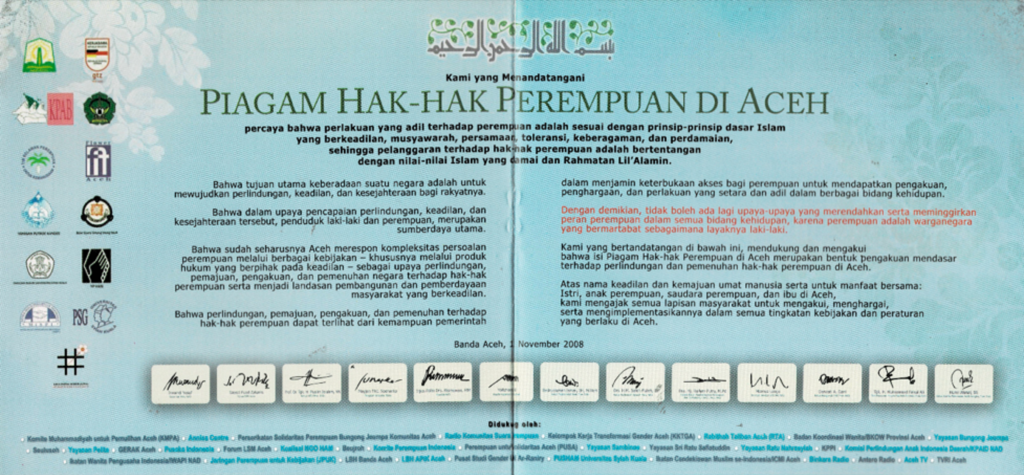
The Acehnese Women’s Rights Charter. Used with permission: Balai Syura archival collection.
Women’s civil society organisations, such as Flower Aceh, with the support of international donors, successfully pushed for the adoption of the Acehnese Women’s Rights Charter in November 2008. This charter, comprising 18 Articles, was a major step forward for gender transformation in post-conflict Aceh because it reflected a broad-based moral consensus among the leaders of post-conflict, political and religious institutions on the rights of Acehnese women.
Despite these formal and moral commitments, women’s activists argue that there has been limited change in women’s lives and livelihoods in Aceh. As Figure 1 shows, narrowing the gender gap in human development (as measured by life expectancy, mean and expected years of schooling, and standard of living) remains a challenge.
Figure 1. Human Development Index by Gender, Province of Aceh 2010-2024
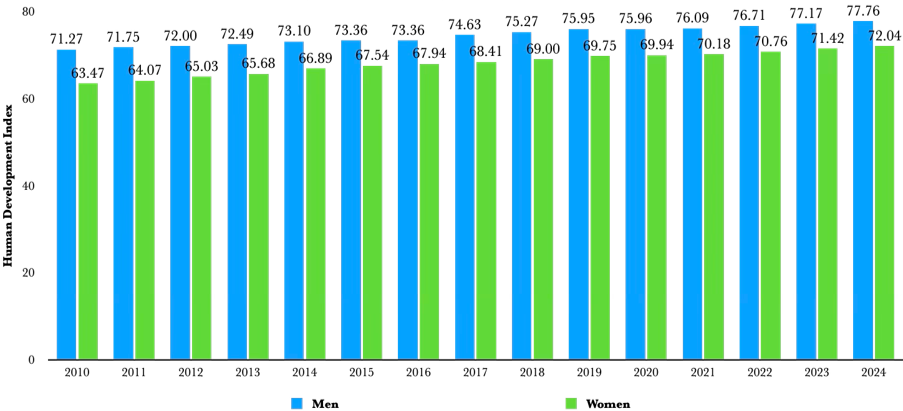
Source: Indonesia’s Central Statistics Agency 2025, compiled by Muhammad Ammar Hidayahtulloh. The Human Development Index is a summary measure of average achievement in key dimensions of human development developed by the UNDP.
Women survivors of conflict-related gender-based violence have yet to receive adequate recognition, reparations, and access to the justice they deserve. Discriminatory rules regulating women’s clothing and limiting women’s freedom have been introduced in some subregions in the province. Meanwhile, the number of women elected to the Aceh parliament has declined from 12 in 2014, to 9 in 2019, and to 7 in 2024, out of the 81 seats.
Patriarchy is embedded in post-conflict politics in Aceh
Although the peace agreement has led to the demilitarisation of GAM fighters, political economist Sait Abdulah argues that the ideology of militarism has been re-institutionalised through both the Aceh Transition Committee, a new organisation of GAM ex-commanders, and the Aceh Party, their political vehicle. Within these institutions, male ex-commanders reasserted their elite status by cultivating the ideal of the ‘warrior hero’.
Militarised patriarchal ideology has helped GAM ex-commanders secure legitimacy and political support from their male and female rank-and-file ex-soldiers and civilian supporters. This political ascendancy of former GAM commanders, while not going uncontested, has led to the Aceh Party’s victory in four consecutive post-conflict legislative elections (i.e., 2009, 2014, 2019, and 2024). The ex-chief commander of GAM, Muzakir Manaf, widely known as Mualem, is both the head of the party and the incumbent governor of Aceh.
We agree with feminist scholars such as Erika Cudworth who have identified the propensity for patriarchal gendered power relations to be reconfigured and reinvented in post-conflict societies. Our study finds that the reconfiguration of patriarchy has actively shaped how little women benefit from post-conflict institutions.
For instance, women ex-combatants were allocated fewer post-conflict resources than men ex-combatants. This was, in part, due to the militarised ideology that constructed ex-Inong Balee as only performing supporting roles—in other words, as not ‘true soldiers’. In this context, women without personal connections and loyalty to male GAM elites struggle to access these resources. In a focus group discussion on 19 April 2026, a few women ex-combatants in Pidie Regency claimed they did not receive any benefits from the state’s reintegration program due to their lack of personal ties with male ex-commanders. Despite this marginalisation, however, they continued to express loyalty to the Aceh Party.
In the domain of electoral politics, although political parties, including local parties, complied with the 30 percent quotas for women candidates mandated by the Electoral Law, they demonstrated minimal substantive commitment to supporting women’s electoral success. A long-serving secretariat coordinator of Balai Syura, a women’s umbrella organisation in Aceh, explained that the organisation had proactively approached political parties ahead of elections since 2009, offering free training and political education on women’s issues and campaign strategies for women candidates (Interview, 14 March 2026). However, the organisation had received almost no positive response from the parties.
Women who experienced a less arduous path to political power tend to have connections to former GAM commanders. This was evident when one of Mualem’s wives, known as Bunda Salma, became an interim replacement for a resigned member of the Aceh parliament. The party reportedly dismissed three male members to enable Bunda Salma to secure the vacant seat. During fieldwork, this controversy arose repeatedly in discussions with women’s activists. One activist remarked ‘just wait and see, Bunda Salma will soon be the next chairperson of the Aceh parliament’, critiquing the access to power that proximity to male elites confers (Interview, 8 April 2026).
The Shariatisation of the social and political order
Islam has historically played a central role in organising social and political life in Aceh. Any transformation (or lack thereof) in post-conflict gendered power relations needs to be understood against this backdrop. The post-conflict period has seen the intensified formalisation of Sharia, alongside the reconfiguration of patriarchal relations.
These two developments are, however, not necessarily inherently intertwined. As documented by historian Sher Banu Khan and political economist Jaqueline Siapno, Islamic traditions and gender egalitarian structures historically co-existed in Acehnese society for centuries. It was the armed rebellion against the Indonesian military, according to Siapno, that catalysed the formation of Acehnese (male) nationalism by ‘construct[ing] Islamic identity into militant, patriarchal lines which restricts women’s roles and mobility’. In this context, the codification of the peace agreement enabled conservative Islamic groups to further formalise Sharia as the foundation of the post-conflict order.
The policing of public morality in the name of Sharia and the politicisation of Sharia have disproportionately disadvantaged Acehnese women and gender and sexual minorities. Women who do not wear Islamic clothing in public can be subject to state sanctions enforced by the Sharia police. In 2018, 12 transwomen in Aceh were arrested following police raids on five hair salons as part of ‘Operation Anti-Moral Illness’.
Given Islam’s centrality in Acehnese society, the women’s movement does not oppose Sharia. Rather, it challenges conservative interpretations underpinning the current system and promotes more progressive understandings of Islam aligned with gender equality and justice, as reflected in the 2008 Women’s Charter.
Several activists we interviewed, reported experiences of intimidation and being labelled infidels (kafir) and anti-Sharia for their advocacy of women’s issues. One activist even received death threats and had to leave Aceh (Interview, 31 March 2026). This experience of threats and repression has shaped the issues and strategies of the Acehnese women’s movement. Some of our interviewees conceived of Sharia in its current form as a ‘brick wall’. For them, finding ‘open doors’ is critical to successful advocacy even though it means they must avoid publicly addressing ‘politically sensitive’ issues, such as LGBTQ+ rights.
The resurgence of authoritarianism
Scholarship on rebel-to-political party transformation has demonstrated that the way conflicts end is an important factor in the emergence of either post-conflict authoritarianism or democratisation. Although negotiated settlements that incorporate former rebel movement into the post-conflict political process tend to increase the durability of post-settlement peace, they do not guarantee that democracy will take root.
The Helsinki agreement has been successful in preventing the conflict parties from returning to the battlefield, in part because the former GAM commanders have transitioned into new roles as political rulers and lawmakers. Nevertheless, the former commanders have developed male-dominated patronage networks, shaped by the wider context of Indonesian politics which is highly predatory and corrupt. We contend that this development has been critical in facilitating the resurgence of authoritarianism in Aceh.
The Aceh Party has dominated the province’s political scene since the cessation of the conflict. But support for the party has gradually waned, as reflected in the consistent decline of the party’s share of the vote in four consecutive legislative elections. Since the 2014 national elections, the party leadership has formed a coalition with Gerindra, the party of current President Prabowo Subianto, a former military commander who has been accused of serious human rights violations. In the 2014 and 2019 presidential elections, Prabowo won 54.4 percent and 85.6 percent respectively of the votes in Aceh.
A young feminist activist expressed her frustration: Now that he [Prabowo] is in power, there wont’ be justice in Aceh. It is not only me who got hurt, but Papuans and East Timorese too (Interview, 30 March 2026).
Under Prabowo’s administration, Indonesia has seen rapid remilitarisation. Only a couple of months after his inauguration, Minister of Defence Sjafrie Sjamsoeddin announced the government’s plan to establish 100 territorial development infantry battalions (Yonif TP), including in four Aceh regencies (i.e., Pidie, Nagan Raya, Aceh Tengah and Aceh Singkil). Human rights organisations and multiple civil society coalitions in Aceh opposed the move, arguing that it risks retraumatising conflict victims and undermines the Helsinki Agreement which limits the number of military personnel that can be deployed in the region.
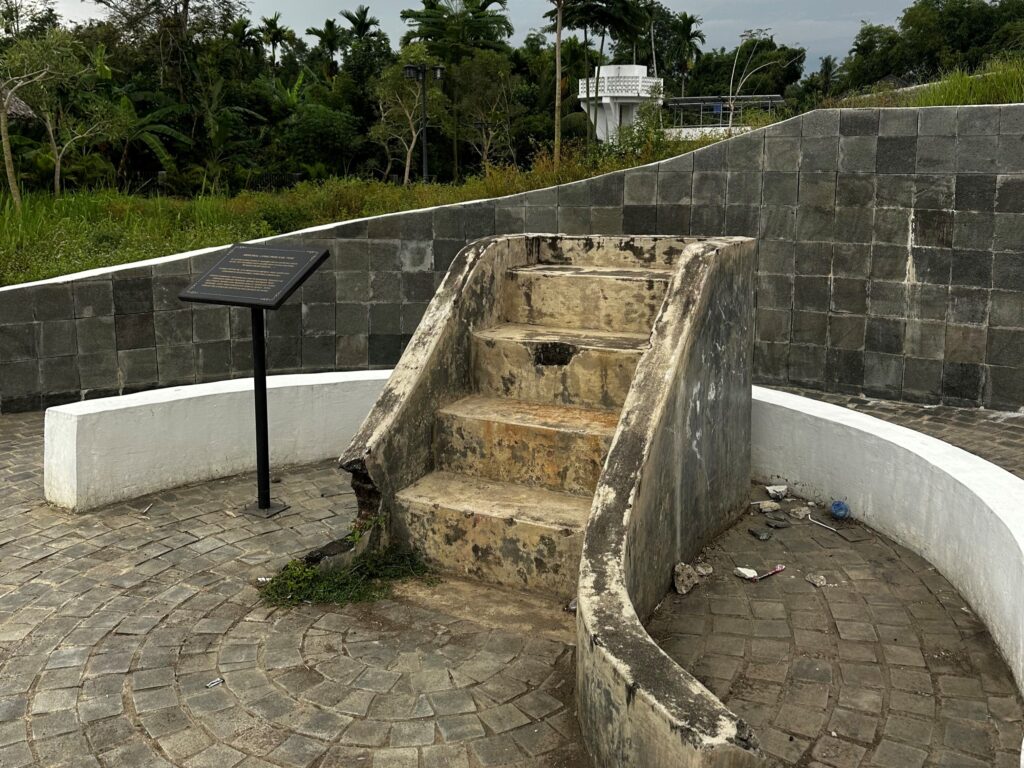
The remaining stairs of Rumah Geudong, now Memorial Living Park, in Pidie Regency. Used with permission: Muhammad Ammar Hidayahtulloh.
The concerns of many women and human rights groups in Aceh regarding increased militarisation were exacerbated by the opening, in July 2025, of the ‘Memorial Living Park’, built on the site of Rumah Geudong, a house that was used as a site of sexual torture during the conflict. The state-led memorial involved the demolition of Rumoh Geudong without consulting victims. Opponents of the memorial released a statement claiming the demolition was an attempt to destroy evidence and erase the history of what happened there. Our interviewees told us that they experienced military intimidation when they organised their own community-led trauma healing initiatives to memorialise the violent conflict: ‘We don’t feel that we are at peace, we are not free to speak. When we speak a bit louder, there are repercussions. Our voices are silenced’ (Interview, 2 April 2026).
Together, the reconfiguration of patriarchy within post-conflict institutions, the formalisation of Sharia, and the resurgence of authoritarianism constitute mutually reinforcing processes that have undermined the Helsinki peace settlement to transform the gendered structures of power that sustain violence and inequality.
Conclusion
Two decades after the Helsinki agreement, Aceh remains an example of both the possibilities and limits of post-conflict transformation.
The end of violent conflict created opportunities for advancing women’s rights and enabled important legal and institutional reforms. However, these gains have been constrained by post-conflict processes that reproduce gendered power inequalities, thereby limiting the extent to which the Helsinki peace settlement benefits women and other marginalised groups. The experiences of Acehnese women demonstrate that peace cannot be measured solely by the absence of armed conflict or the durability of a peace agreement. Rather, as Samsidar and other Acehnese women activists envision, lasting peace requires an ongoing commitment to transforming the old and new gendered structures that sustain violence and reproduce inequalities. The Acehnese women’s movement has continued to struggle against the current and articulate alternative visions of feminist peace.
Authors: Dr Muhammad Ammar Hidayahtulloh and Dr Shelli Israelsen
Acknowledgements: We are grateful to all the respondents for generously sharing their time, knowledge, and experiences with us throughout this research. We would also like to give special thanks to our research assistant, Uchra Mustika, for her support during the field research in Aceh. This research was funded by a Starter Grant (Startersbeurs) from the Nijmegen School of Management, Radboud Universiteit, awarded to Dr Shelliann Israelsen.
Main image: Women’s leadership in strengthening the community economy supported by Flower Aceh, 15 April 2026. Credit: Used with permission from Muhammad Ammar Hidayahtulloh.