A functioning public healthcare system should be a core requirement for a legitimate claim to sovereignty in international law, in Myanmar and elsewhere.
Key words: Myanmar, political legitimacy, sovereignty, public healthcare, international law.
International law inadequately regulates non-international armed conflict (NIAC) because it gives substantial deference to state sovereignty while paying insufficient attention to whether a state continues to fulfil the responsibilities that justify sovereign authority. Using Myanmar as a case study, we contend that the legitimacy of a state’s claim to sovereignty should be qualified by its fulfilment of critical medical and public health obligations.
The article advances three related arguments:
- Firstly, that the provision of essential healthcare and public health services should be regarded as a core condition of legitimate sovereignty.
- Secondly, that linking sovereign legitimacy to the discharge of medical and public health responsibilities would expand protection for both medical and public health workers.
- Thirdly, that such an approach could support peacebuilding and international engagement by creating stronger incentives to preserve health systems during conflict.
Although we recognise that health is inherently political and can itself be instrumentalised during conflict, we conclude that a state’s willingness and capacity to protect the health of its population should be treated as an important indicator of sovereign legitimacy, particularly where competing claims to authority arise during civil war.
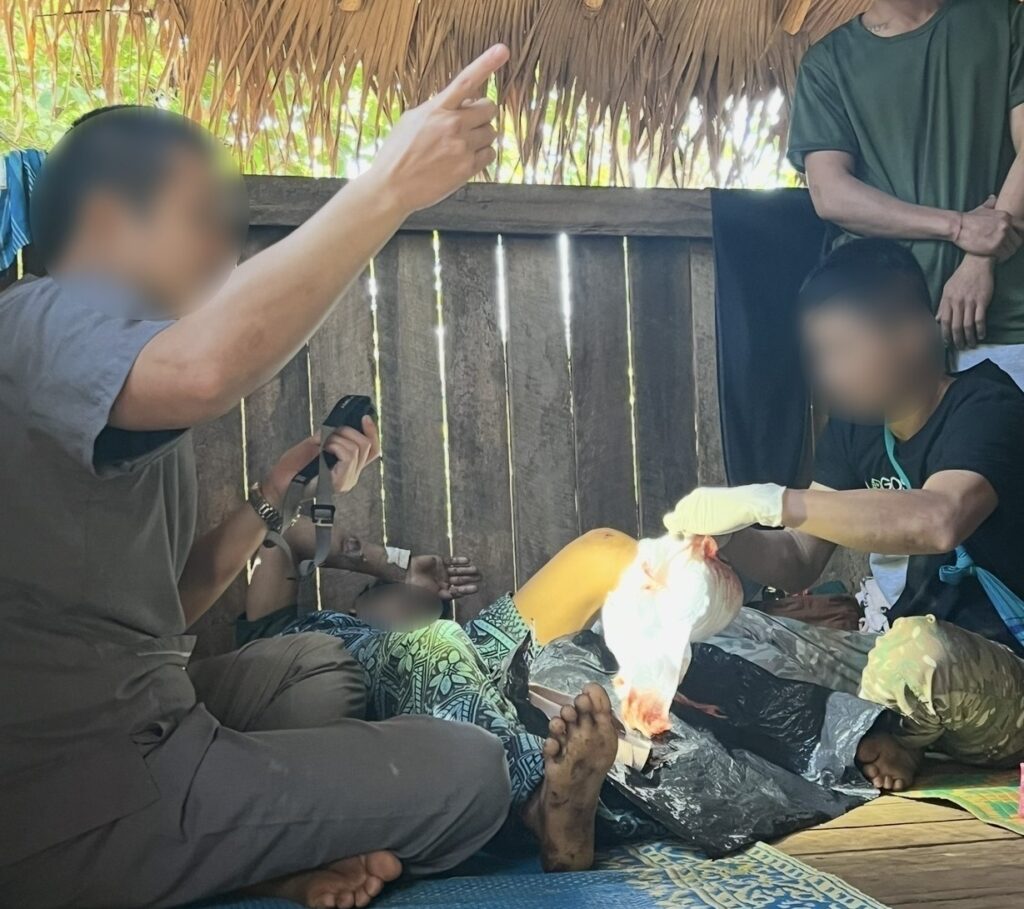
A surgeon and an assistant treat a patient injured in an airstrike. The location, hospital name, and training institution have been withheld for security reasons. Credit: Dr Phyu Phyu Thin Zaw.
The current context of Myanmar
Myanmar’s public health is in a dire state, with an estimated 16.2 million people in need of humanitarian aid, including essential health services. Since the military coup in 2021, the World Health Organisation’s Surveillance System for Attacks on Health Care recorded sustained and verified attacks by the military junta on medical and public health facilities and workers suspected of providing aid to pro-democracy protesters, members of the Civil Disobedience Movement, or anti-junta resistance groups.
Residents in many of the territories where the military junta has lost effective control are most impacted. Access to humanitarian aid is mainly through ‘underground’ high-risk channels, such as through local groups that can bypass checkpoints to distribute aid discreetly. Formal channels are blocked by the junta in its attempt to weaken resistance groups and their civilian sympathisers through food blockages, humanitarian restrictions and forced conscription.
Some action has been taken by the global community to hold the military to account under international law through legal avenues including the International Court of Justice and the International Criminal Court, as well as by Timor-Leste, but progress has been slow and hampered by geopolitical division. Five years after the coup, the people of Myanmar continue to be deprived of critical medical and public health support.
International law on non-international armed conflict
It is well recognised that the law governing non-international armed conflict (NIAC) remains underdeveloped when compared with the legal framework applicable to international armed conflict, leaving significant gaps in the regulation and humanisation of civil wars.
The conflict in Myanmar is one of 67 NIACs identified in recent global studies of armed conflict during 2024-2025. Against this backdrop, we do not argue for the creation of a standalone body of law governing NIACs or for the displacement of the principle of state sovereignty. Rather, we contend that international law currently gives excessive deference to sovereign authority by failing to scrutinise whether a state continues to fulfil the fundamental responsibilities that justify that authority. In particular, a state may continue to invoke sovereignty and its monopoly on the lawful use of force even when it has failed to provide critical medical care and public health protection to populations affected by armed conflict.
We do not suggest that a state’s sovereign claim is extinguished by failures in public health governance during armed conflict. Rather, we argue that the legitimacy of a state’s claim to sovereignty should be qualified by its fulfilment of critical medical and public health obligations. Sovereignty should not be understood solely as a source of authority, but also as a function of responsibility. Where a state persistently fails to protect the health of populations under its control during a NIAC, international law should accord less deference to assertions of sovereign prerogative and greater weight to humanitarian considerations. The three reasons for this position are set out below.
Healthcare provision as a core condition of legitimate sovereignty
The rights and duties of a state should include the provision of, or at least the non-obstruction of access to, a minimum level of public health and medical services for its permanent population, especially during a NAIC.
The four criteria for statehood in the Montevideo Convention are: a permanent population, a defined territory, government, and a capacity to enter into relations with other states. It is silent on the duties of states regarding medical and public health systems, but other international law instruments recognise medical and public health, as well as related human rights, as obligations that qualify the powers of sovereign states, including the Constitution of the World Health Organisation (WHO), the International Covenant on Economic, Social and Cultural Rights, the WHO’s International Health Regulations, and (prospectively) the Pandemic Agreement. Sovereignty could be argued to include duties of a state to exercise its governmental authority in ways that protect the health of its populations. We consider this to be supported by the work of scholars who show that health has special normative importance because it is foundational to state legitimacy in its internal and external dimensions.
Even during a civil war, a state may retain strong internal legitimacy among its population by choosing not to weaponise health and continue to provide essential medical and public health services. For instance, Nepal was noted to have improved 16 of 19 major health indicators during the Maoist insurgency between 1996 to 2006, while Sri Lanka was able to preserve its core public health functions to eliminate malaria during its civil war from 1983-2009. A functioning health system can underscore the legitimacy of a state’s claim to sovereignty as its capacity to perform a core function is demonstrated.
Similarly, a state is more likely to secure or maintain external legitimacy by protecting medical and public health infrastructure and by meeting its commitments under international law. Notably, the wider global community has an interest in the assurance that a state is capable of responding effectively to an infectious disease outbreak to prevent it from escalating into a pandemic. Additionally, ongoing initiatives to develop and implement a multidimensional approach to evaluate state legitimacy is a promising means of explicating state duties in relation to critical medical and public health needs. It is beyond the scope of this article to elaborate on what a minimum level of public health and medical services should be, but we note that there is a rich body of work on this topic.
Strengthening the protection of medical and public health workers under international humanitarian law
A clear link in international humanitarian law between state legitimacy and the effective discharge of a state’s medical and public health duties would help strengthen legal protection of medical and public health workers (and infrastructure).
International humanitarian law has traditionally focused on protecting personnel engaged in the treatment and care of the wounded and sick, whereas public health workers often perform broader functions such as disease surveillance, vaccination programmes, sanitation, water security and health system administration. In practice, however, these categories frequently overlap, particularly in conflict settings where healthcare delivery and public health functions are closely integrated. We argue, therefore, that the legal and normative protections given to medical workers should be extended to public health workers whose activities are equally essential to protecting population health and maintaining critical health system functions during armed conflict.
Common Article 3 of the four Geneva Conventions does not explicitly mention public health workers and other medical personnel. It protects persons not actively participating in hostilities from murder, torture, hostage-taking, degrading treatment, and unfair trial, and requires the collection and care of the wounded and the sick. But the protection of medical personnel arises only through implication as a necessary corollary of the obligation to care for the wounded and sick.
Public health workers are only protected if they are assigned to medical or health-related functions. Otherwise, public health workers are protected as civilians if they are not directly participating in hostilities. Where applicable, Additional Protocol II to the Geneva Conventions explicitly states that ‘medical personnel’ shall be respected and protected in civil wars but makes no mention of public health workers. Similarly, medical personnel exclusively assigned to medical duties are protected under customary international humanitarian law (specifically Rule 25 of the International Committee of the Red Cross), but no mention is made of public health workers whose work (e.g. managing water, sanitation and public health programs) are not medical duties in a strict sense.
Since the military coup in Myanmar, human rights groups and monitors have recorded almost 2,000 incidents of violence against healthcare workers and attacks on facilities across the country. Approximately 65 percent of these attacks were attributed to the Myanmar Armed Forces and have resulted in the deaths of 175 heath workers and the arrest of 932 more. While there is no specific data on public health workers, multiple sources have reported that civilians are frequently and deliberately attacked by the military junta and other armed groups. Such actions are clearly in contravention of Common Article 3, even if Myanmar is not a party to Additional Protocol II.
Although international law already provides significant protections for medical personnel, we argue that the discharge of critical medical and public health functions as a core requirement to legitimacy could increase accountability and extend protection to public health workers.
Enabling peace-building initiatives
Qualifying the legitimacy of a state’s claim to sovereignty by reference to its fulfilment of critical medical and public health obligations could strengthen incentives to preserve and rebuild health systems during armed conflict and create greater space for constructive engagement with international health actors.
This argument does not rest on the assumption that health is politically neutral. A substantial body of scholarship has challenged the notion that health exists outside politics, highlighting that decisions concerning the allocation of resources, access to healthcare, prioritisation of populations, and the design and delivery of health services are deeply embedded within political structures and power relations. Health systems may therefore be used not only to promote wellbeing but also to reinforce exclusion, consolidate state authority, or advance strategic objectives in conflict settings. The distribution of healthcare can itself become a battleground in which competing claims to legitimacy are asserted and contested. In such circumstances, the failure of a state to provide equitable access to essential health services should be treated as a relevant consideration in assessing the legitimacy of its sovereign claims.
Recognising the political character of health does not diminish the importance of cooperation with international organisations such as the World Health Organisation. Rather, it underscores the need for international engagement where domestic health governance has become fragmented or instrumentalised. Although it may be unrealistic to expect a state engaged in conflict with segments of its own population to facilitate healthcare outreach on an equitable basis, international law should nevertheless encourage and, where appropriate, pressure states to cooperate with humanitarian and public health initiatives that extend essential services to all affected populations. This objective is reflected in the World Health Organisation’s Global Health and Peace Initiative, which seeks to strengthen the contribution of health programmes to dialogue, social cohesion, resilience and, ultimately, peacebuilding in fragile and conflict-affected settings.
Nevertheless, the relationship between health and peacebuilding is itself complex. While health interventions can provide opportunities for dialogue and confidence-building, they may also reproduce existing inequalities or exacerbate tensions if access to services is perceived as discriminatory. WHO has itself recognised both that health can function as a platform for cooperation and that inequitable health-service delivery may intensify conflict dynamics. Greater recognition should therefore be given to the practical challenges of pursuing peacebuilding through health systems and health-related interventions. Qualifying sovereign legitimacy by reference to critical medical and public health obligations would not transform health into an apolitical domain. Rather, it would acknowledge that states derive part of their legitimacy from their capacity and willingness to protect the health of populations under their control; and would provide a stronger normative basis for international actors to support inclusive and conflict-sensitive health interventions where those obligations are not being met.
Before the military coup of February 2021, a health-system convergence roadmap was developed by ethnic health organisations, government stakeholders and international partners to address the longstanding fragmentation between Myanmar’s national and ethnic health systems. Emerging from the country’s peace process and associated discussions surrounding the 21st Century Panglong Conference, the convergence model proposed the gradual alignment of service delivery, governance arrangements and referral mechanisms across competing health systems.
Beyond its public health objectives, the model was explicitly conceived as a peacebuilding strategy, drawing on the WHO’s ‘health-as-a-bridge-to-peace’ framework to foster trust, cooperation and political dialogue between the central government and ethnic actors in conflict-affected regions. This framework was also intended as a practical application of the ‘health-as-a-bridge-to-peace’ initiative by leveraging health system alignment to support wider political peace negotiations. Other initiatives such as a Swiss-funded primary healthcare project in border areas, and the auxiliary midwife training programme in Kayin State operated on a similar rationale. Since the coup, however, public health and medical personnel from the state sector left junta-controlled facilities, mainly as part of the civil disobedience movement, for ethnic health and community-based health organisations operating along the border regions. Increased armed hostilities rendered cooperation difficult, with many of these initiatives now focused mainly on localised needs and access to humanitarian aid, rather than peacebuilding.
With healthcare and public health functions being contested by the military junta and the National Unity Government (mainly composed of elected lawmakers ousted by the coup), Myanmar is excluded from the World Health Assembly, the decision-making body of the WHO, and hence unable to apply the Global Health and Peace Initiative without recognised state leadership. WHO’s Country Office in Myanmar currently operates through a localised Health Emergency Appeal (funded through voluntary contributions, institutional donors, global emergency pools and philanthropic partners) to help manage the protracted humanitarian crisis, but it is unable to implement any of the structural elements of the Global Health and Peace Initiative.
If a claim to sovereignty is explicitly made dependent on meeting critical medical and public health needs of the populations to which that claim applies, this could be an important means to establish legitimacy of a governing authority. At the time of writing, the military junta holds Myanmar’s official seat at the WHO, but it lacks administrative control over large swathes of the country. Despite sustained junta attacks and limited international aid, the National Unity Government and allied local groups have built alternative primary care systems in regions such as Sagaing where junta-controlled health centres have stopped operating. Through digital platforms, the National Unity Government and overseas diaspora networks run remote medical consultations, conduct ethics reviews, and coordinate underground medical and public health volunteers and mobile clinics. While the NUG’s medical and public health efforts have received substantial informal validation and support, there is, as yet, no clear means of formal recognition for the purposes of implementing the Global Health and Peace Initiative.
Conclusion
Existing global governance and diplomacy structures of peacebuilding for health are ineffective, even in countries experiencing conflict where health is not weaponised. In the context of Myanmar, we argue that the explicit recognition of health should be a core requirement for a legitimate claim to sovereignty in international law. This could help to ensure that victims of non-international armed conflict receive support to meet critical medical and public health needs, strengthen protection of health personnel and related infrastructure, and help enable peacebuilding through the World Health Organisation’s Global Health and Peace Initiative.
Just as the weaponisation of health should not be ignored and go unpunished, efforts that allow victims of non-international armed conflict to meet their critical health needs should be recognised and supported by the global community.
Main image: A nurse (face burred for security reasons) and Dr Phyu Phyu Thin Zaw, a medical doctor, providing care to a male malaria patient in a remote village in Chin State, Myanmar. Credit: Dr Phyu Phyu Thin Zaw.