What is the utility of ‘legitimacy’ as a concept? The Myanmar military regime does not face a legitimacy crisis, but rather a compliance crisis.
Key words: Myanmar, political legitimacy, military regime, compliance.
Generations of schoolchildren in Myanmar have been admonished that education is a pot of gold which can’t be stolen (pannya shwe-o, lu ma ko). The admonition is both simple and clever. Its simplicity is in its likening being educated to possessing a valuable object. Its cleverness is in its reflexivity. The analogy works because it is exposed. Why can’t education be stolen? Because unlike a pot of gold it does not materially exist.
Legitimacy occupies a place in political and social scientific imagination today akin to education in this admonition. If education is a necessity for children, then legitimacy is a thing that presidents, strongmen and revolutionaries cannot, we suppose, do without. While it is by now a platitude to say that legitimacy is a contested concept (what social scientific concept is not?) it is simultaneously one that denotes a certain common sense. Legitimacy is assumed to be attainable, and for those political leaders and regimes who attain it, it is assumed to be good. Everyone wants more of it. Nobody can do without it.
The basic task for political researchers, then, is to sort out how to observe and measure legitimacy. Who has more and who has less? How do they get it? Why do they lose it? These are the kinds of questions that they are invited to ask when we apprehend legitimacy as a thing that exists in the world. We might not be able to say exactly what it is or how it works, but it is there, doing things that we have to do our best to describe and interpret.
The thing is, that is not how the political world works; not in Myanmar, not anywhere. It is not a pile of brute facts that we can observe and quantify. It consists in the meanings that we assign to the actions of those whom we observe, which we communicate with others. If legitimacy exists, then it is by virtue of intersubjective meaning-making.
That being so, who on earth needs it? Do political actors really need legitimacy? Do political researchers? To say that political actors need it presupposes that they can possess more of it if they successfully communicate that their rule is rightful. To ask whether that is the case is to query the general proposition that ‘all governments fear a loss of political legitimacy’. To say that political researchers need it presupposes that it is an essential tool in our conceptual kits. To ask whether they do is to query whether there might not be other, better concepts with which to infer things about the political worlds we observe. What follows are some notes on each of these queries, in turn, insofar as they are relevant to research on Myanmar since the 2021 military coup.
Does Myanmar’s military need legitimacy?
Influential political scientist Samuel Huntington once called legitimacy a ‘mushy concept that political analysts do well to avoid’. Yet no sooner had he recommended avoiding the term than he added that legitimacy ‘is essential to understanding the problems confronting authoritarian regimes’. From where, he asked, do authoritarians obtain the right to rule? That is to say, whence do they gain legitimacy?
On its face, this looks like a question that we should be asking of Myanmar’s army, or sittat. Though its statecraft is abysmal, the sittat, which is the overwhelmingly dominant part of the country’s armed forces, has been unusually successful, compared to counterparts worldwide, in repeatedly securing its interests against those of its adversaries. Surely, political theory intuits, legitimacy has something to do with it. No regime can rule through violence or threat of violence alone. Power, or authority, depending on what these terms denote, need a degree of rightfulness.
Working from that intuition, the task for students of politics in Myanmar today is reduced to figuring out how military power there is made rightful, and legitimacy created and maintained. despite the regime being anti-democratic. There are many ways that they might acquit themselves of the task. They might take a leaf from, and study military use of, religious rituals and kingly symbols to insinuate itself with a certain type of legitimating power, hpoun. They might ask questions about how the sittat has since 2021 sought to recover legitimacy, initially by insisting that the National League for Democracy won the 2020 election fraudulently; subsequently by taking steps toward the reestablishment of semi-elected legislatures in 2026. Or they might puzzle over the sittat’s post-legalistic insistence that it has adhered to the 2008 Constitution, even if to make this claim at all required of it that it kidnap the country’s civilian president and replace him with a military deputy.
To be sure, the parts that Buddhist ritual, monarchical symbolism, Potemkin polls and palimpsest constitutionalism play in the making of military rule in Myanmar all deserve scrutiny. The question is not whether they are worthy of inquiry but whether they are, after all, evidence of a regime trying to build its stock of legitimacy. If we assume that all governments need legitimacy, then it looks like they are. But what if we do not?
In her research on the Hafiz al-Asad regime in Syria, Lisa Wedeen shows that the assumptions political scientists have about authoritarian rulers’ search for legitimacy might not be well founded. The problem with Huntington’s imperative, she demonstrates, is that it mistakes a thinner, instrumental politics of ‘as if’ for legitimacy. Presupposing that all governments fear a loss of legitimacy misguides inquiry because it takes as given that authoritarian rule must somehow be morally justified, when it might be transparently insincere to everyone involved.
Asad senior, Wedeen shows, wasn’t trying to accumulate legitimacy. What he sought, and got, was subjects performing compliance. Nobody believed that Asad was the nation’s ‘premier pharmacist’ or that he got over 99 per cent of the vote in national elections. But it didn’t matter to his regime that nobody believed. What mattered was that people acted as though they did. By complying with orders to participate in rallies, hang paraphernalia, and police speech, Syrians were rendered accomplices in schemes for their own subjugation. The Asad regime did not produce legitimacy, but an ‘anxiety-inducing simulacrum’ of the kind of loyalty that a political regime with legitimacy acquires.
Jennifer Leehey is right to observe that Wedeen’s account of Syria resonates with conditions in Myanmar before its troubled, decade-long dalliance with democracy of the 2010s. The social world of the 1990s and 2000s was one in which people in Myanmar, like Syrians, were assembled to be seen but not heard, and habituated to utter slogans and perform gestures that were not legitimating, but that produced a veneer of conformity. It was one in which military juntas refused the very notions of right on which legitimacy claims would otherwise depend. Theirs was a world full of announcements that everything was moving ahead all at once, while in reality people fashioned their lives out of institutional debris.
That state rituals and media performances were patently absurd did not undermine military rule because the sittat did not need legitimacy. What it needed was compliance, which is not only demonstrated but best obtained by people acting as if performances that are patently absurd are not. That is the point that Wedeen makes of Syria and Leehey of Myanmar: absurd performances are compliance producing, not legitimacy creating. It matters that they are absurd. What is patent absurdity for, but to secure compliance? To be sure, such absurd performances and rituals were not the sum total of the military state’s activities to defend its interests and keep opponents in check throughout the 1990s and 2000s, and to point to them as absurd is not to be so crude as to say that everything about what the military did then was absurd. It is only to insist that if we ask legitimacy-type questions about such activities then we are missing the point.
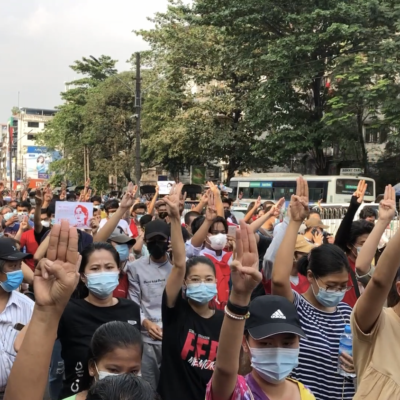
It follows that since its 2021 coup, the sittat, whose tactics change with circumstances, but whose strategies iterate, has not confronted a legitimacy crisis. What it has met with is a recurrent compliance crisis, albeit one that is different in its particulars because of how Myanmar society was transformed in the 2010s. The crisis has manifest in two ways. First, it has manifest in the unprecedented numbers of people who have declined to be rendered its accomplices in their own subjugation. These people filled cities and towns in protest at the coup; who walked out of their jobs as teachers and nurses, bureaucrats and soldiers. The sittat did not respond by attempting to persuade them of the rightness of its position, as a government scrambling to shore up legitimacy might. It responded, predictably, by shooting, beating, abducting and torturing; by threatening, prosecuting, capturing and imprisoning. Many of those who evaded its violence themselves took up arms with which to fight back. Others resisted through a host of creative non-violent methods. What they did not do was concede to conform.
Second, because of social and technological change of the last decade, the sittat lost control of the symbolic realm. Coup leader—now self-appointed president—Min Aung Hlaing was awarded the monicker ‘motherfucker’ (his initials in Burmese are the same as those for an obscene spoonerism) and the sittat redescribed as a pack of running dogs, sitkwe. The military has since worked at regaining control of the symbolic realm. But it would be a mistake to interpret its efforts here as being designed to shore up legitimacy. If the problem is a compliance crisis, then its solution has been, once again, to recover a veneer of conformity. The task is not to try to persuade anyone that Min Aung Hlaing is not a ‘motherfucker’ or that the sittat is not a dog pack, but to assemble enough people in legislatures and other arrangements under military control to act as if he were a statesman, and the sittat, a professional army.
So legitimacy is not, on this account, what the sittat fears losing. But that does not make legitimacy irrelevant to it. To the extent that it is locked in a ‘legitimacy struggle’ it is not because of its own need for it, but because it must destroy the legitimacy of its political and military opponents.
Rebels, on Zachariah Mampilly’s often-cited account, have to strive to achieve a kind of embryonic statehood in order to gain and sustain legitimacy among people who are subjected to their rule. Researchers of Myanmar have shown that they do this in various ways, including by building self-esteem among insurgent grassroots, and providing policing and judicial services to their constituencies. Leaders of long-established para-states, such as the Karen National Union, point to their record of defending self-determination as one basis for their legitimacy. Though they may struggle to meet their constituencies’ material needs, they succeed ideologically where the sittat either fails or fails to try. For the relatively newly established Arakan Army, the project has concentrated on getting effective control of territory and populations to enlist in a racial supremacist program that is filling the vacuum left by the 2017 genocide. And for the National Unity Government, established in 2021 to act as a proxy for the elected government denied office, the tasks have been to build basic administration while fighting a defensive war on the ground, lest it have a moral argument without territory or people, and to present itself internationally as a viable alternative to the military.
These nascent state-making endeavours are all military targets for the sittat. In the 2010s it targeted them by outflanking adversaries materially. Since 2021 it has reverted to sustained, indiscriminate physical violence aimed at the infrastructure that its enemies are trying to build in order to stake their claims, and the people whom they are trying to serve.
So once again, it seems, we are back in the legitimacy wheelhouse. Even if the sittat can run on compliance, its opponents cannot. Or are we? Are there other ways that we might apprehend the situation?
Do Myanmar researchers need other concepts?
Suppose that legitimacy is not like a pot of gold that political actors aspire to acquire. Instead, to use a different analogy, suppose it is a pair of tinted glasses through which a political researcher observes the political world. Legitimacy is on this account something that is in front of the eye of the beholder, not in the world that they observe. It follows that if they change glasses, they will see different things.
Like what? Broadly speaking, there are two approaches to concept formation and use. In one, the researcher might start with a different, readily available abstract concept, with which to observe the same political or social phenomena that they might with their legitimacy glasses. This could be an Anglophone cognate for legitimacy, such as ‘moral authority’, which can be repurposed to orient research toward different kinds of questions about rightful rule from those that are typically asked by researchers working with the concept of legitimacy; for instance, questions about the everyday politics of custom that attend to the variability of authority in undemocratic settings. Or it could be a concept from among the beliefs that make up the building blocks of a ‘moral universe’ in which many Buddhists in Myanmar organise their social and political worlds; or, relatedly, from the literature on comparative political thought, which displaces Eurocentric ideas about the political world.
Another approach starts with particular category of person or institution or figure that in some way embodies or captures a salient political idea or ideas. The category could be one of the researcher’s own devising: ‘moral authorities’ that are identifiable as having attributes or engaging in activities that speak to the abstract principle, for example. Or it could be an institution or figure that is present in the research site, from which they might glean things about the principles that inform and guide political order in Myanmar.
Consider how, for instance, a political theory of the military state that started with sitkyawye—the archipelagic spaces for interrogation of political enemies that dot Myanmar—might differ in its observations and interpretations from one that begins with legitimacy. For all the articles and chapters that have addressed the problem of political legitimacy in Myanmar, none have, to my knowledge, taken sitkyawye seriously as a political institution. Yet sitkyawye is, arguably, the paradigm of military statecraft in Myanmar; more revealing of how the sittat operates than any of those specified in the country’s constitutional order, precisely because unlike all those institutions it is essential to what the military state is and does.
Alternatively, what would an account of political order in Myanmar today comprise if it centred on the figure of the informer, or dalan, rather than, say, the office of the president? Andrew Selth has pointed to public perceptions that informers are everywhere in Myanmar as evidence of the country’s ‘trust deficit’. These observations are important. Yet, to take dalan seriously in our political inquiries calls for more than a description of the situation in which they are present. It asks of us that we treat them, like sitkyawye, as somehow archetypal of military statecraft; the dalan, rather than the member of legislature or judge or policeman, a truer representative of what that statecraft involves and what it stands for.
A political study of dalan would not have the same results as one starting with the presidency or addressing questions of legitimacy. But that is the point. By shifting seemingly peripheral institutions and figures to the centre of inquiry we can observe practices and make inferences that might allow us to identify what beliefs animate political violence in Myanmar today on terms that are not those that a theory of legitimacy would invite.
That is not to say that, in doing so, the goal is to make theories of legitimacy, or work that uses the concept, look foolish. It is, rather, to have researchers of politics in Myanmar, and elsewhere, pause to consider what alternative concepts and methods exist that they might employ to study politics in Myanmar that do not lead us down the same well-trodden paths signposted ‘legitimacy’.
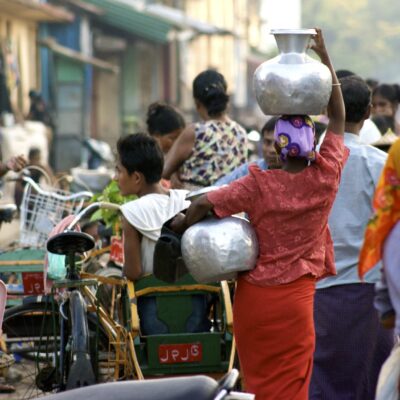
Image: A street scene in the city of Mawlamyine, Myanmar. Credit: James Antrobus/Flickr.