
The relationship between the Ainu, Japan’s Indigenous people, and Hokkaido tourism has become increasingly close in recent years. This shift was marked by the 2019 enactment of the Ainu Policy Promotion Act, aiming to support not only cultural revitalisation but also broader measures to support Ainu people, and by the 2020 opening of Upopoy, the National Ainu Museum and Park. These milestones signalled a new era in which Ainu culture is actively presented to national and international audiences through tourism. Across Hokkaido, Ainu culture has become more visible in visitor experiences, from craft markets to cultural performances and guided tours.
Simultaneously, criticisms have emerged regarding cultural appropriation in tourism contexts and wider cultural industries. Ainu words and traditional motifs are increasingly used in souvenirs, promotional materials, and branding, often by non-Ainu business operators with little understanding of their cultural contexts and significance. In some cases, Ainu-inspired designs are reproduced without permission and sold for others’ profit, undermining Ainu people’s cultural stewardship and seriously impeding Indigenous-led economic and social empowerment through tourism. For many Ainu, the use of motifs or linguistic expressions outside of cultural protocols reduces their heritage to a market commodity, disconnecting cultural elements from their lived contexts.
Against this backdrop, this article highlights how Ainu communities in Hokkaido, particularly the Lake Akan and Biratori regions, are exploring practical measures to protect Ainu Intellectual Property (IP) in the tourism sector, often in collaboration with local governments and non-Indigenous operators. By focusing on these initiatives, I explore how Ainu communities, tourism stakeholders, and municipal governments interact on the ground, revealing opportunities alongside persistent challenges.
Responses to Indigenous Intellectual Property in tourism contexts
International frameworks
Indigenous IP protection has become a prominent issue in international policy and academic debates since the adoption of the United Nations Declaration on the Rights of Indigenous Peoples (UNDRIP) in 2007, with the World Intellectual Property Organisation (WIPO) and other bodies developing frameworks to address the shortcomings of conventional IP law.
The conceptual foundation for Indigenous IP was articulated in 1994 by Erica-Irene Daes, former Special Rapporteur of the United Nations Sub-Commission on Human Rights, in her influential report ‘Protection of the Heritage of Indigenous People’. Building on this work, Daes collaborated with WIPO and UNESCO to expand the scope of Indigenous IP, helping shape the global recognition of Indigenous rights over interconnected domains such as traditional cultural expressions and expressions of folklore developed and maintained by Indigenous communities. They include music, tales, performance, design, architectural forms and traditional knowledge related to environmental management, biology, and resource use. These ideas informed later international instruments, including the Convention on Biological Diversity (Preamble and Article 8) in 1992 and the Convention for the Safeguarding of the Intangible Cultural Heritage in 2003.
The UNDRIP reaffirmed these principles, particularly in Articles 11–13 and 31, which recognise the rights of Indigenous people to maintain, control, protect, and develop their cultural heritage. Thus, the UNDRIP exposed the inadequacy of conventional IP regimes, designed primarily for individual creators and limited durations, in addressing collective, intergenerational forms of cultural knowledge and creativity. In response, WIPO further elaborated concepts related to IP and traditional knowledge through its WIPO International Committee on Intellectual Property and Genetic Resources, Traditional Knowledge and Folklore in 2008, and has since advanced negotiations towards sui generis frameworks for the protection of traditional knowledge and cultural expressions.
National approaches
Nations such as Aotearoa New Zealand, Australia, Norway, Finland, and Canada have introduced diverse mechanisms to strengthen Indigenous control over cultural and economic representation, including certification schemes for authentic products, Indigenous trademarks, and community-developed tourism protocols through non-statutory countermeasures. In Canada, for instance, the Indigenous Tourism Association of Canada operates ‘The Original Original’ accreditation programme, which certifies tourism businesses that adhere to culturally appropriate representation and community benefit principles. In the academic arena, the Intellectual Property Issues in Cultural Heritage project, based in Canada, produced the educational guide ‘Think Before You Appropriate: A Guide for Creators and Designers‘, which promotes ethical engagement with Indigenous heritage by illustrating examples of misappropriation and why it matters for both Indigenous people and non-Indigenous business operators. This guide has been translated into Japanese and shared with Ainu artisans in Lake Akan and Biratori. Furthermore, several countries such as Panama, Aotearoa New Zealand and Taiwan have enacted sui generis laws to protect Indigenous IP.
These developments demonstrate that safeguarding Indigenous IP is not solely a legal or economic issue, but also a question of Indigenous peoples’ cultural sovereignty, self-determination, and sustainable participation in global cultural and tourism economies. Collectively, these examples reveal that Indigenous IP protection within tourism is not simply about restricting access but also establishing ethical and equitable relationships with Indigenous and non-Indigenous stakeholders, promoting consent-based representation, and ensuring community control over how heritage is shared with the world.
Japan’s current legal framework
IP laws in Japan, comprising industrial property rights such as patents, utility models, designs, and trademarks, along with copyright, do not provide a mechanism for protecting the collective IP of the Ainu as an Indigenous right. For example, under the Copyright Act, which protects individual creative works for a limited duration, collectively inherited cultural expressions and traditional motifs passed down within specific regional communities fall outside the scope of IP protection.
Although the Ainu Policy Promotion Act provides partial support for IP-related initiatives, it does not explicitly define or protect Indigenous IP, nor does it recognise the Ainu people’s collective rights. Additionally, whilst Article 2 of the Act defines ‘Ainu culture’ as ‘the Ainu language, way of life, music, dance, crafts, and other cultural products that have been inherited by the Ainu people, and the cultural products that have developed from them’, it does not include explicit reference to Indigenous IP, traditional knowledge, or traditional cultural expressions as distinct legal categories. Academic and policy discussions in Japan concerning comprehensive IP and traditional knowledge protection, as advocated by the international frameworks, also remain limited. Filling this gap, Japan’s Ainu communities are beginning to explore similar protective measures within tourism.
Within Japan’s Ainu policy framework, efforts to ensure the revitalisation and transmission of culture have increasingly intersected with the promotion of tourism and the branding of Ainu crafts. A report submitted by the Advisory Council for Future Ainu Policy emphasises the need to strengthen measures that would connect cultural activities with the Ainu people’s economic self-reliance. These include ‘improvements in the skills for traditional Ainu handicrafts and a broadening of their market; the establishment of an Ainu brand; the appropriate mobilisation of Ainu culture as a tourism resource and its incorporation into a tourist destination; and the promotion, domestically and abroad, of tourism based on Ainu culture’.
Building on this recommendation, the Ainu Policy Promotion Act introduced practical measures to support these aims. Under the Act, projects for developing demand for goods and services specified in the Regional Ainu Policy Promotion Plans approved by the Prime Minister can receive reduced application fees when registering Regional Collective Trademarks. However, despite these efforts, Japan’s current legal system for IP still lacks provisions to protect Ainu IP, and its approaches remain relatively localised and fragmented.
Ainu tourism and emerging local initiatives for IP
Nevertheless, local Ainu communities have begun taking independent steps to protect their IP. Amongst them, the Lake Akan Ainu’s strategy offers a notable case.
Case study 1: Lake Akan Ainu
Located near Lake Akan in Kushiro City, Eastern Hokkaido, the Lake Akan Ainu kotan (village) is amongst the most prominent centres of Ainu tourism. From the early 1900s, the Maeda family, an ethnic Japanese household, owned land around Lake Akan. In 1954, the third-generation head, Mitsuko Maeda, donated part of the land to local Ainu residents as a free loan, triggering the establishment of the present-day kotan. A community workshop for craft production was established soon after, followed by a dance theatre and exhibition hall. Benefitting from its proximity to the region’s hot springs, the kotan developed strong ties with the tourism industry. Although this provided opportunities for cultural transmission and skill development amongst local Ainu, they also faced the negative consequences of the industry being dominated by non-Ainu operators, including the unethical commercialisation of Ainu culture. In the 2000s, as interest in Ainu culture surged, instances of cultural appropriation also increased.
In response, Ainu members formed the Akan Ainu IP Study Group as a consultation body for local tourism operators. Building upon this foundation, the Akan Ainu Consuln, a general incorporated association, was founded in 2019 to protect Ainu IP through Indigenous-driven management, supported by the national subsidy under the Ainu Policy Promotion Act. This organisation aims to transmit authentic Ainu culture and promote Ainu-driven branding projects by connecting business operators interested in integrating Ainu culture into their enterprises. When external business operators make requests to the Akan Ainu Consuln, representatives of the kotan deliberate on whether to accept the project and which traditional knowledge holders or artisans would work on it.
To date, the Akan Ainu Consuln has supervised and certified Ainu motifs, language, performances, lectures, and cuisine, and certified products carry the official label issued by the Akan Ainu Consuln (Fig. 1, left). Depending on the request, traditional knowledge holders or artisans may produce new works grounded in local traditions, or the Akan Ainu Consuln may authorise motifs from its regional design archive. This certification and collaboration system enhances Indigenous control over cultural representation whilst ensuring fair benefits to the Ainu people through design fees and royalties. Around the same time, the Akan Ainu Consuln has launched the Akan Ainu craft brand together with local artisans. Their artworks are labelled trademarks that verify products are genuinely created by the Akan Ainu Consuln (Fig. 1, right).
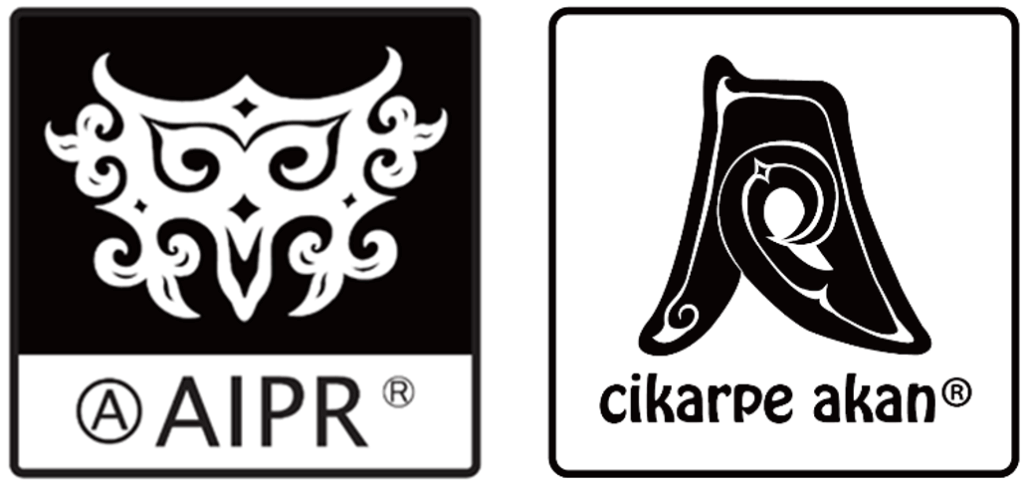
Figure 1.Official labels for Akan Ainu Consuln Certification (left) and Akan Ainu Authentic Product (right). Photo permission granted by Akan Ainu Consuln.
Case study 2: Biratori Town
Biratori Town has pursued a more institutionalised approach through the Regional Collective Trademark for Ainu craft. Located in western Hokkaido, Biratori’s Nibutani area, with a relatively high Ainu-descendant concentration, has long served as the centre of Ainu cultural practices. During the Hokkaido tourism boom in the 1960s, a cooperative workshop was established to produce and sell handicrafts as local Ainu souvenirs; the Nibutani ita and Nibutani attus are especially renowned. The ita is a shallow wooden tray whose surface bears traditional Ainu carved patterns characteristic of the Saru River Basin, where Nibutani is located. The attus is a woven textile made from fibres of the inner bark of trees, such as Ulmus laciniata (elm), produced through knowledge and techniques that have been passed through generations in the community. In 2013, both were officially designated as traditional crafts by Japan’s Minister of Economy, Trade and Industry. This designation, the first in Hokkaido and the first for Ainu craft, requires the items to utilise traditional materials and techniques with at least 100 years’ history. Following this recognition, public interest in Ainu craft increased further, but imitation products resembling Nibutani craft began appearing in souvenir shops elsewhere in Japan. In 2024, to protect local artisans’ IP rights and strengthen Ainu crafts’ value, local stakeholders led by the Nibutani Ainu Crafts Cooperative, together with the local municipality and a general corporative association, Biratori Urespa, responsible for training Ainu craftspeople, successfully registered the Regional Collective Trademark for both Nibutani ita and Nibutani attus, clarifying their cultural attribution and protecting ownership.
Persistent challenges and future pathways: Towards a framework for Ainu IP in Japan
The cases of Akan and Biratori illustrate two distinct yet complementary approaches to protecting Ainu IP within the tourism context. The Akan’s approach emphasises an Ainu-led certification model that foregrounds Indigenous agency and dialogue with tourism stakeholders. The Akan Ainu Consuln promotes ethical representation by certifying cultural expressions, such as designs, language, performances, and cuisine, based on local Ainu-led decision-making. Biratori’s path has been more institutional and legalistic, employing a Regional Collective Trademark system to formalise the attribution of specific craft traditions, such as Nibutani ita and Nibutani attus. Whilst Akan’s approach centres on relational ethics and co-creation, Biratori focuses on formal recognition and market legitimacy.
Limitations of the models
Neither model offers comprehensive legal safeguards against cultural appropriation nor provides collective rights. Both rely heavily on local efforts, administrative support, and voluntary compliance rather than enforceable Indigenous authority. Moreover, in both Akan and Biratori, local communities can certify or protect only those aspects of Ainu IP that originated within their own regions. This situation stems from Japan’s unique institutional context, in which the individual identification of Ainu people is administratively difficult, and no recognised mechanism exists for collective Indigenous membership or representative organisation. The collective Indigenous rights advocated by the UNDRIP have yet to be acknowledged in Japan. Despite decision-making and co-creation with the Lake Akan Ainu, there are no legislative guarantees regarding the representativeness of the Akan Ainu Consuln and their IP protection. In Biratori town, the Regional Collective Trademark was registered as a result of collaboration between multiple local stakeholders. However, the Nibutani Ainu Crafts Cooperative alone could not meet the eligibility criteria required to apply for a regional collective trademark.
Consequently, in the current framework, where Ainu IP protection is grounded not in the individual or collective rights of Indigenous peoples, but in the broader policy goal of cultural revitalisation and promotion, successful initiatives like those in Akan and Biratori have depended on the presence of established local Ainu organisations responsible for cultural transmission, consistent collaboration with municipal governments, and access to national funding schemes delivered through local administrations. To expand such efforts beyond these favourable local conditions into a broader, Hokkaido-wide initiative, future pathways need a sustained national–local dialogue on Ainu IP protection.
Nevertheless, these initiatives demonstrate how, despite the absence of a national sui generis system for Indigenous IP, local Ainu and their allies are exploring a mechanism to counter the realities of the tourism industry. They reveal the potential of community-based governance and municipal collaboration to bridge the gap between Ainu IP protection and economic participation.
Conclusion
Building on these experiments, the next step involves developing a comprehensive Japan-wide framework that integrates Ainu-led principles of cultural guardianship into both legal and non-statutory mechanisms capable of recognising collective and intergenerational IP.
The feasibility of the next steps for the legal mechanism will depend on how the Japanese government addresses the collective rights of Indigenous peoples in policymaking. At the same time, it is evident from the case studies in Akan and Biratori that these local initiatives can drive wider involvement from actors in the tourism and cultural industries, fostering awareness of Ainu IP and shared responsibility for it beyond the efforts of Ainu communities alone. The development and deployment of non-statutory mechanisms in various regions can help address these legal shortcomings by putting collective principles into practice. This can also lay the groundwork for establishing stronger legal mechanisms.
Main image: Entrance of Lake Akan Ainu Kotan, December 2022. Credit: Author.