Indigenous items or works of art displayed in museums often have ambivalent status. In the best of cases, they are material diplomats as peoples encounter and learn from one another in a spirit of mutual respect. In the worst of cases, they may be hostage diplomats if they were acquired in illegitimate or dubious ways disrespectful of the source communities.
Indigenous peoples worldwide have sought sovereignty over their cultural heritage as reflected in museum collections and exhibits rather than letting museum professionals interpret items strictly from ethnographic or historical frameworks; especially since the United Nations Declaration on the Rights of Indigenous Peoples (UNDRIP) was passed in 2007.
The demands of Indigenous communities have led to changes in museological practice and government policy, even if museums and states still maintain ultimate control. These changes have enabled some museums to be transformed into arenas for collaborative partnerships, repatriation of cultural belongings and human remains, as well as for decolonisation. Taken together, museums are potentially public forums for Indigenous diplomacy in the era of cultural resurgence and reconciliation.
Indigenous knowledge in Taiwan and Japan
Indigenous knowledge makes cultural and linguistic revival relevant to contemporary challenges such as political recognition, economic and ecological sustainability, and peace between peoples. This is especially important in the Indo-Pacific, which is home to 67 percent of the world’s Indigenous peoples.
Ancient trade networks once linked the Ainu of Japan with the Indigenous peoples of Alaska, the Aleutian Islands, and the Arctic. Many Indigenous peoples in the Pacific, including the Hawaiians, the CHamoru, and the Māori can all trace their ancestors to the Austronesian migration that spread out from Taiwan in ancient times. As newer and more frequent relations between Indigenous peoples are made possible by globalisation, these new relationships draw upon historical norms of Indigenous diplomacy and sharing.
How can museums contribute to global dynamics of diplomacy, cultural resurgence, and reconciliation?
There are many historic relations between Indigenous peoples. Gathering together can help Indigenous people consider common issues and share their approaches.
In April 2025, Indigenous people and practitioners shared best practice in relation to partnerships with museums at a meeting in Ottawa, Canada. It was held under the auspices of the Global Cooperation Training Framework, an agreement between Taiwan, the United States, Japan, Australia and Canada to utilise Taiwan’s expertise to address wide-ranging issues of mutual concern.
The April meeting focused on Indigenous engagement, cultural revitalisation and repatriation within the context of museums and contemporary museological practices. Drawing on direct experience, empirical research and case-studies, speakers discussed the different ways museums in Taiwan and Japan, among others, are striving to foreground Indigenous perspectives and engage Indigenous communities through the co-curation and co-design of exhibition content and interpretive narratives; and through collection research, conservation, and repatriation programs. These best practices were exemplified in two leading museums in Taiwan and Japan.
Taiwan’s National Museum of Prehistory
The Director of Taiwan’s National Museum of Prehistory, Futuru Tsai, a co-author of this article, described how the museum’s newly renovated exhibition spaces, particularly ‘The Prehistory of Taiwan’ and the ‘Austronesian Hall’, accentuate Indigenous voices from Taiwan and the broader Austronesian region.
According to Tsai, ‘exchanges between Indigenous communities are crucial’ (2025) and the NMP is increasingly collaborating with Indigenous scholars and curators from across the Austronesian region. One such collaborator is Liam Koka’ua, from the Ngāti Ārera tribe of Rarotonga (Cook Islands), and a curator at Auckland Museum. In this forum, Koka’ua shared his research on Indigenous resource management and discussed how museums can integrate Traditional Ecological Knowledge (TEK)—an Indigenous worldview centred on the interconnections between living beings and the environment—into exhibition practice.
Despite its name, the National Museum of Prehistory seeks to become a leading hub for cultural revitalisation and cultural diplomacy across Austronesia. The archaeological collections, such as those of the Dapenkeng culture, have connections with today’s Indigenous peoples and are indispensable in studying the origins of Austronesian peoples across the Pacific. The permanent exhibition and other facilities underwent a major renovation in 2023, notably by bringing the voices of contemporary Indigenous peoples and their social movements into the 6,000-year history of Austronesian peoples on the island. The museum has outlined a mission statement that emphasises stronger partnerships with Taiwan’s Indigenous peoples, as well as Indigenous peoples across the region.
Cultural revitalisation begins with public acknowledgement of the Indigenous ancestors and their deep connections to the land on which the museum was constructed. In the exhibits, the goal is not to represent or reconstruct Indigenous material cultures of the past, but rather to contribute to cultural revitalisation for the future. The NMP highlights trans-Pacific practices including navigation and voyaging, traditional ecological knowledge, particularly in marine environments, and Austronesian arts of tattooing. These goals, along with other public education activities, are to be realised through active collaboration with Indigenous groups in Taiwan and across the Austronesian communities of the Pacific and Island Southeast Asia.
Two out of four management-level departments are led by young Indigenous professionals, and the Museum plans to hire Indigenous curators. The Museum has a reputation for being a trusted partner, as most notably demonstrated in 2023 when the skulls of Indigenous Paiwan people killed in the 1871 Mudan Incident were returned to Taiwan from the University of Edinburgh, and the Paiwan entrusted the skulls to the Museum for safekeeping.
Futuru Tsai also discussed the spiritual dimensions of his work. In 2009, long before he knew he would take on his current role, he visited Papua New Guinea, where he was gifted three Japanese military name tags that had formerly belonged to the Takasago Volunteers, Indigenous people from Taiwan who served in the Japanese war effort. He donated them to another museum. In 2023, on a visit to the NMP, he unexpectedly found one of the tags on display. As director, he was able to bring all the tags to the museum for curation and exhibition. He felt as if the spirits of those Takasago Volunteers wanted him to take on his current role in order to bring them to a final resting home.
Japan’s Hokkaido University Museum
Cultural revitalisation has also been important in museum practice at the Hokkaido University Museum, as Koji Yamasaki, also a co-author of this article, learned in 2009 from his experience organising the exhibition ‘Teetasinrit tekrukoci, The Handprints of our Ancestors – Ainu Artefacts Housed at Hokkaido University – Inherited Techniques’.
The planning of this exhibition was based on two principles, and both contribute to cultural revitalisation. The first was to encourage more Ainu individuals to visit the museum located in the Hokkaido University Botanical Garden to encounter Ainu artefacts. The second was to explore with Ainu artisans the present-day meaning of these items. These two principles made it possible for Hokkaido University and Ainu people to explore directions for joint projects and led to reflection on the future of the museum.
In preparation for the exhibition, the museum invited contemporary Ainu artisans to make replicas of Ainu items at the museum, listened to their impressions and opinions on the artistic process, and then exhibited the resulting series of reproductions. This was not an entirely new process, as several of the artisans had previous experience of making replicas. One of the most important lessons learned was that, for Ainu artists, there is a difference between replicas and copies. The production of replicas is a creative act that creates new works of art while allowing the artist to get as close as possible to the work created by their ancestors. The original items and the replicas were displayed side-by-side in the exhibition.
Professor Yamasaki reflected that he had learned that the contemporary artisans developed an affinity with the original producers. Several artists said that moving their hands like their ancestors helped them imagine how they felt when they produced them. Secondly, by suppressing their own habits and individuality while making them, they learned about the rules (or tradition) of their manufacture. They could then use the techniques they obtained to make future works. The artists said that the project increased the admiration and respect they had for their ancestors, which made the process key to cultural inheritance and revitalisation.
The revival of Ainu artistic practice is important for the future. Many of the artefacts conserved in the museum have been there for more than 50 years and have begun to deteriorate with age. Their restoration depends on rediscovering traditional technical rules. Such projects can help the Ainu revitalise key elements of their culture. Professor Yamasaki stressed the need for international exchange in this context. An example is the Atayal artist Yuma Taru from Taiwan, who has used the term ‘reappearance’ to restore Atayal weaving traditions and produce new works of art. Her work has been displayed in Taiwan and Japan, as well as at the National Gallery of Canada in Ottawa and Australia. Yuma is also a key participant in a long-term Australia-Taiwan First Nations Art Exchange Research Project led by Sophie McIntyre, the lead author of this article, in collaboration with the National Museum of Prehistory.
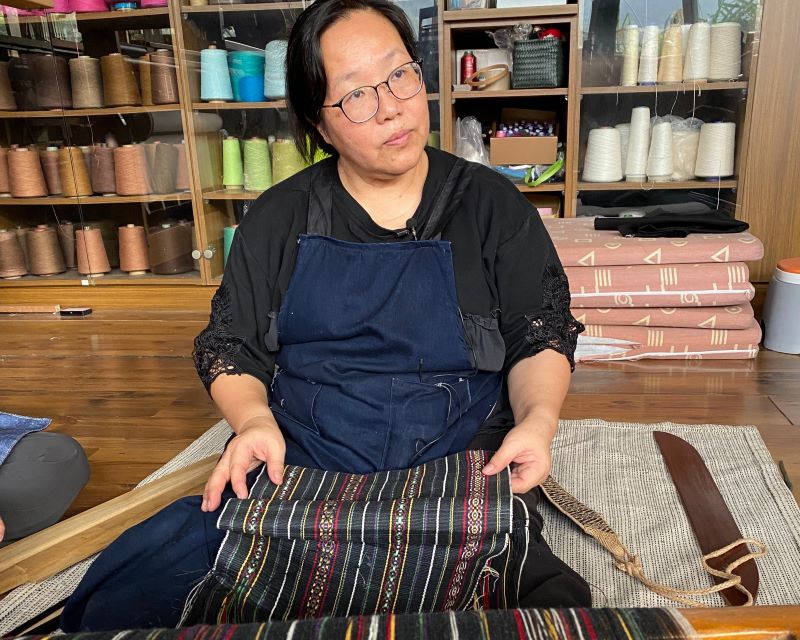
Atayal artist, Yuma Taru, 2025. Credit: Sophie McIntyre.
More inclusive approaches in museums
While varied in their specific approaches and contexts, the strategies and perspectives of the National Museum of Prehistory in Taiwan and the Hokkaido University Museum reflect broader movements towards recognition and reconciliation in settler-colonial contexts; as well as parallel global shifts in critical museology and decolonial theories that question and challenge traditional power dynamics, and advocate for more inclusive approaches in museums. Métis scholar and artist David Garneau advocates for the term ‘perpetual conciliation’ instead of ‘reconciliation’. He states, ‘Rather than accept the idea that there was a prior period of conciliation, we recognize the fact that the need for conciliation is perpetual. Conciliation is an ongoing process, a seeking rather than the restoration of an imagined agreement. The imaginary produced without Reconciliation emphasizes post-contact narratives: the moment of conciliation settled as if it were a thing rather than a continuous relationship’.
Drawing on museum and exhibition case-studies in Australia and Taiwan, Sophie McIntyre explored the relationship between cultural policy and developments in museological practice, particularly regarding Indigenous engagement and partnerships, along with training and employment opportunities at museums. As Australian First Peoples curator, educator and artist Genevieve Grieves observes, working with Indigenous people and Indigenous culture ‘requires shifts in work practices, it demands innovation and doing things differently, it asks people to think “inter-culturally”, and it depends on genuine partnerships.’
Within this framework, museums are increasingly seen as relational spaces where authority is shared, and where collaboration with Indigenous communities is not only possible but essential.Such partnerships are central to acknowledging, prioritising, and embedding Indigenous knowledge, value systems, and cultural practices within institutional processes, curatorial narratives and modes of representation.
Cultural revitalisation, also referred to as cultural regeneration and renewal, is a key concern for many Indigenous communities seeking to reclaim, restore and transmit Indigenous customs and practices that were supressed or disrupted by colonisation and assimilationist policies. As a community-led process, cultural revitalisation plays a central role in strengthening cultural identity and pride, as well as intergenerational knowledge transfer and community resilience. Cultural revitalisation can also serve as a mutually beneficial site for collaboration between Indigenous communities and museums.
Conclusion
The discussions at the Global Cooperation Training Framework workshop in Ottawa led to a surprising revelation about the nature of Indigenous artefacts in museums: These artefacts serve a diplomatic role, facilitating understanding and connections between nations and cultures. At the same time, they are also time-traveling diplomats between generations. Around the world, Indigenous knowledge, customs, and practices were suppressed or disrupted by a century or more of colonisation and assimilationist policies. New relationships between museums and Indigenous communities have fostered community-led initiatives that enable the rediscovery of traditional arts and techniques. Engaging with these cultural objects—and uncovering the methods behind their creation—helps strengthen Indigenous identity and pride. They then return to their communities to apply what they learned in intergenerational knowledge transfer and contribute to community resilience. To the extent that they engage in these processes, museums can effectively facilitate cultural revitalisation with leadership from Indigenous people themselves.
For millennia, the Indigenous peoples of the Indo-Pacific have traded with one another, creating a spectrum of cultures and technologies spanning Australia, across the Pacific Ocean, and even to the West Coast of Canada. Colonisation disrupted most of those connections and practices, but now globalisation is enabling new kinds of Indigenous diplomacy and collaboration. With new practices of partnership and collaboration, museums are emerging as arenas where Indigenous peoples from across the Indo-Pacific can meet, share strategies, and educate Indigenous and non-Indigenous visitors alike about the ties that bind them across distant oceans. The world has much to gain from this new kind of Indigenous diplomacy.
Authors: Dr Sophie McIntyre, Prof Scott Simon, Prof Futuru Tsai & Prof Koji Yamasaki.
Main image: A display at the National Museum of Prehistory, Taiwan, 2025. Credit: Sophie McIntyre.