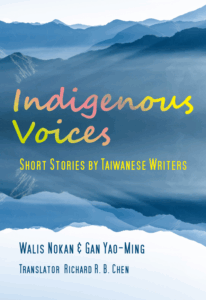
‘Indigenous Voices: Short Stories by Taiwanese Indigenous Writers’, by Walis Nokan and Gan Yao-Ming, translated by Richard Chen, is a significant contribution to Asia-Pacific Indigenous literature.
Taiwan is home to many officially recognised Indigenous groups, each with distinct languages and traditions. These communities have fought hard to maintain cultural continuity in the face of marginalisation and poverty under colonisation and assimilation policies over centuries.
The two stories in this book, ‘Lady Wasi’ by Walis Nokan and ‘Have a Bite of Ghost’ by Gan Yao-Ming, reflect on poverty in Taiwan around the first half of the 1900s. Readers are invited to empathise with life journeys that unfold as struggles but lead, at times, to success. In this way, the stories remind us of the many twists and turns that life presents, particularly for colonised peoples navigating the enduring impact of colonialism.
Both stories address relationality (the understanding that everything is defined by connectedness), survivance (the active cultural continuation of Indigenous peoples) and cultural continuity (enduring individual and collective identities).
The short biographies of the authors—Wallis Nokan, an Atalya writer, and Gan Yao-Ming, a Hakka writer engaged with Indigenous cultures) invite empathy and connection with them which creates a sense of meeting and acknowledging connection or relatedness, the shared sense of Being Indigenous.
‘Lady Wasi’ by Walis Nokan
‘Lady Wasi’ is set at an unspecified time during the Japanese colonial period (the late 1800s until 1945) in Taiwan’s upland logging regions. The story portrays workers in the logging industry, many of them Indigenous, enduring dangerous and harsh conditions meted out by the Japanese forestry company boss described as having a ‘cruel image and tough way’. The workmen, with only a ‘crudely built shed no better than a pig pen’ to go back to, spent ‘day-after-day toiling at the inhumane job’. with ‘headhunting Atayal warriors hidden in the grass’.
Into this environment arrives ‘Lady Wasi’, a charismatic young Indigenous woman whose world ‘should be borderless and varied’ and who ‘was not made to be a traditional, chaste woman’. For the forestry workers she was like ‘a flower in a field of buffalo excrement’, working as a housemaid during the day and ‘moonlighting at the work shed…comforting men and getting rich’. Lady Wasi had plans for a better future and noticed someone who might be part of it. This man was a hard worker who saved his money and didn’t participate in the gambling and sexual games of the others. He promised her an unspecified ‘gift too precious and covert to be discovered’. They left the logging work together: ‘Both of them did not look back’. Their sons became successful merchants, and their grandsons became ‘high officials in the capital’.
My interpretation of the ‘gift’ is that it was the opportunity to continue Lady Wasi’s family line to pass on resilience to future generations. The ‘gift’ may also refer to the more basic promise of a better life with her husband. Nokan, a well-respected writer, skillfully portrays the inequity and terrible treatment of Indigenous peoples in Taiwan as well as their strategies to cope with oppression—unfortunately a common theme for colonised Indigenous peoples.
‘Have a Bite of Ghost’ by Gan Yao-Ming
The second story continues the theme of survivance but in a different context. ‘Have a Bite of Ghost’ shifts to domestic space and scarcity. It recalls a family’s coping strategies during famine (WWII and its aftermath) through the perspective of a child narrator. The story starts with a reflection on the importance of tongues in eating and their association in folklore with desperate/hungry ghosts. Readers engage with the child experiencing an intense focus on food and preoccupied by whether the family will ever get to enjoy a substantial meal, even the simple joy of eating plain rice which was considered a delicacy in comparison to the usual meal of yams. We sympathise with the child as he experiences relentless hunger and preoccupation with food, especially when his hopes are dashed by older members of the family being given first preference at mealtimes. This is tempered by others’ perspectives, especially his mother, who – while seemingly unsympathetic to her son’s constant nagging for food – is revealed to work extremely hard to put food on the table and puts others’ needs before her own.
The narrative balances gravity with humor, tenderness, and adaptation. Making light of difficult situations is a common coping strategy among Indigenous peoples and other minority groups suffering through imposed harsh conditions. The family balances each member’s needs under difficult circumstances and there’s the hint of better times at the end, indicating survivance and cultural continuity.
The translation
Chen’s translation underscores the ethical complexity of cross-cultural interpretation. I wondered whether something was missing in translation. Being raised in urban Australia, I have only ever spoken English. From this positioning, I can appreciate how translation to English could miss the nuances of the stories’ original language, Chinese, but also the complexity of telling stories of Indigenous peoples in Chinese rather than Indigenous languages. Chen’s decision to retain certain terms (such as those present in Hakka) signals an ethical stance: meaning is relational and cannot always be fully transposed into another language, reminding readers that understanding is partial and that speaking and thinking in a language is where the true meaning lies.
Indigenous people are the only ones able to have an Indigenous perspective. Our cultural knowledge that we are born with, the influence of our family, and also wider experiences of life make us who we are and govern how we see and understand the world. This also explains how we understand each other. As an Indigenous person, when speaking with another Indigenous person, there is a camaraderie, a sense of common understanding and shared experience of colonisation. While this is the case, it is also necessary to respect the brilliant diversity of Indigeneity around the world. This book provides the reader with an opportunity to realise that important point.
Conclusion
‘Indigenous Voices’ honors cultural specificity while inviting global solidarity. The two stories are distinctly different and yet share the struggles of Indigenous Taiwanese peoples, centering survivance and asserting Indigenous presence under colonial or economic constraint. Together, the texts frame Indigeneity as multifaceted, resisting reduction to a single narrative. They may also resonate through a sense of global Indigeneity and create points of connection across cultural contexts. For educators and scholars, the collection offers rich opportunities to engage with comparative Indigenous perspectives on land, language, kinship, and survival. The editor’s pairing of these two stories likely aims to establish that Indigeneity is diverse, adaptive, and deeply relational. To read this collection is to recognise kinship in difference and be transformed by realising the world through others’ eyes.
Main image: Taiwan’s central mountain range. Credit: Fred Hsu/WikiCommons. Book cover used with permission from the publisher.