Uncertainty, opacity and contradictory messaging—including the cycle of imprisonments, release and re-arrests—in this context are not incidental. They are part of the system of terror in Myanmar.
Key words: Myanmar, military government, political prisoners, mass amnesties
Myanmar’s traditional New Year, Thingyan, is a time of renewal and public celebration. This year, it brought the release of some 4,300 prisoners in a mass amnesty ordered by junta leader Min Aung Hlaing, who earlier this year was declared President of Myanmar after sham elections and had previously led the coup against Aung San Suu Kyi’s elected government.
For families of detainees, even the possibility of release carries enormous emotional weight. Images of prisoners walking free—among them the acclaimed filmmaker Shin Daewe—circulated, briefly, with exaggerated expectations of what the amnesty might signify. The release of President Win Myint, a close ally of Aung San Suu Kyi, added to a sense that something, perhaps, was shifting.
But to understand what these annual releases mean, we suggest that they must be placed within the wider architecture of detention, violence and control that has developed since the coup in February 2021. The central question is not how many were released. It is how the releases fit into a system that continues to use imprisonment as a method to suppress opposition of any sort, including peaceful protests.
Huge numbers of political prisoners
Since the military coup, Myanmar has undergone an extensive campaign of political repression—remarkable even by the standards of a country that has spent much of its post-independence history under military rule. According to the latest figures from the Assistance Association for Political Prisoners, more than 30,000 people have been arrested for opposing the military government. Of these, over 14,000 remain in detention, with thousands more cases which cannot be fully verified due to legal and extra-legal obfuscation by the authorities.
Annual mass amnesties have also become routine since the coup. This year’s release was, in fact, slightly smaller than the roughly 4,900 prisoners freed around the same time in 2025. As in previous years, only a small fraction, estimated at around 150, were political detainees.
In addition, many people have been killed while participating in peaceful protests, during interrogation or in custody. Both Amnesty International and Human Rights Watch report figures of around 2,000 deaths in custody. These figures are likely to be underestimates, as many prisoner details cannot be properly checked, partly because the system is chaotic and over-crowded and partly because of deliberate obstruction on the part of the junta to deliberately create fear. Using a broader definition that includes civilians, pro-democracy activists, and members of armed groups ‘who were arrested or captured and then killed’, the Assistance Association for Political Prisoners places the total number of deaths in detention at around 8,000 as of May 2026. Despite the challenges of definition and verification, the numbers convey the sense that large scale imprisonment is a key instrument of political control.
The rapid expansion of arrests has placed severe strain on Myanmar’s prison system. Although reliable data are scarce, multiple accounts (we can’t be more specific due to security concerns) point to significant overcrowding, and deteriorating conditions. Many prisons in the territories under government control have undergone substantial building expansion since 2022, including Naypyidaw prison in the capital and the infamous Insein Prison in Yangon, presumably to accommodate an expanding prison population.
What is striking is not only the magnitude of the numbers, but their persistence. Arrests have continued year after year, even as amnesties have been announced. The overall system has not shrunk. It has stabilised at a high level and the expansion of prison-building suggests something of a long-term systemic trend.
Private expressions of grief and solidarity are punishable
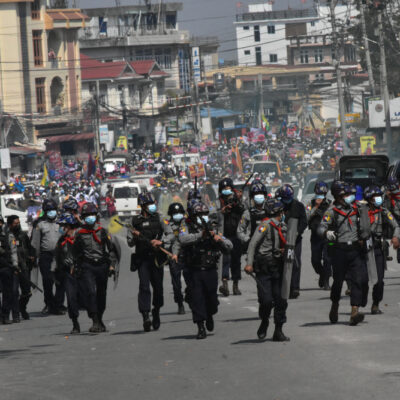
A recent report from the UN Special Rapporteur says ‘Even the smallest acts of defiance—banging pots and pans; participating in a ‘silent strike’ by staying at home; buying, selling or carrying flowers on Aung San Suu Kyi’s birthday; posting a blank black panel on social media to mourn a deadly attack—have led to arrest and imprisonment. When the junta has not been able to secure the arrest of an individual, it has often arrested family members, holding them hostage in an effort to compel the wanted individual to surrender herself. Dozens of children have reportedly been held as hostages.’
Such broad and vague remit of punishable offence, in effect, obliterates the distinction between public dissent and private expression of grief and solidarity. Such methods make detention not only punitive but coercive—a means of compelling surrender through pressure on relatives. Young professionals who have been able to flee overseas after having participated in post-coup pro-democracy activities remain concerned that even their activities overseas might impact on their friends and family back home.
For detainees and their families, imprisonment is therefore particularly prolonged and uncertain, shaped by a system in which legal outcomes are difficult to predict and information is scarce and undependable.
Rumours, obfuscations and contradictions are part of a campaign of fear
Some activists, based on our general analysis of social media and unofficial sources, argue that rumours about releases are deliberately planted, and sometimes picked up by the global media, but do not in fact materialise. Rumour mills go into overtime in the weeks preceding Thingyan and independence day, in anticipation of the annual amnesty. Earlier this year there were persistent rumours that four senior members of the Suu Kyi government were to be released. This did not materialise.
Rumours that Suu Kyi herself was to be returned to house arrest either in Yangon or in Naypyidaw, were quashed when it became clear from eye-witness accounts that both possible residences were severely damaged and remained uninhabitable. Suu Kyi remains in detention at an undisclosed location. The reduction of her sentence, announced as part of the amnesty, amounts to little as the remaining term would see her released at an implausibly advanced age of 105.
The release of President Win Myint had generated some optimism amongst Myanmar observers and activists. However, reports from Naypyidaw say that his residence remains heavily guarded, giving the appearance of a house-arrest rather than release.
Extremist views spread on social media as well as in Myanmar’s traditional media around the time of the prisoner releases have added to concern. Perhaps the most remarkable instance is a post by Hla Swe, which gained more than1,000 Facebook shares and 14,000 ‘likes’. Hla Swe, nicknamed ‘Bullet’, a former high-ranking army officer and Member of Parliament from the pro-military Union Solidarity and Development Party, posted a video claiming powerful leaders such as Vladmir Putin and Xi Jinping, usually kill their enemies. He went on to complain that Min Aug Hlaing and other senior members of his government were ‘too generous, too empathetic’. He concluded ‘Recently released people like U Win Myint are not important. They are like snakes without a head. The important thing is not to put the head back on the body of the snake. If (head is) put back on, the snake becomes poisonous. This is my warning…’ Many read this video as a direct threat to Suu Kyi’s safety, or as a precursor to or even an acknowledgement of her death.
During the same New Year period in which prisoners were freed, military operations continued. Airstrikes in Sagaing region targeted villages and a monastery, killing some civilians and injuring others. These incidents are consistent with a broader pattern of attacks on non-military targets.
Many activists see the rumours, obfuscations and contradictions as part of the government’s efforts to trap activist networks into revealing themselves. Such tactics of official secrecy and unofficial rumours are neither new nor unique to Myanmar. And whether or not these are deliberate or simply represent contradictions inside the junta leadership, the chain of arrests and releases, rumours and secrecy add to the atmosphere of anxiety and helplessness.
The legal system operates as an instrument of control
It is impossible to work out how many people are detained arbitrarily and interrogated without being charged. However, the period in custody before formal charges are laid is regarded as the most dangerous period for detainees, who have reported many forms of torture including rape. Trials, when they occur, are often conducted in closed courts. Legal processes provide little transparency and limited opportunity for defence.
There is however an elaborate, if rubbery, legal framework underpinning imprisonments.
The 1923 Official Secrets Act—a colonial-era statute famously used to prosecute Suu Kyi and her Australian adviser Sean Turnell—has been used expansively to prosecute political opponents, journalists and former public servants. The law’s broad and ambiguous provisions allow authorities to criminalise a wide range of activities, often without needing to demonstrate clear harm to the state. In some cases, prosecutors are not required to prove intent, lowering the threshold for conviction and increasing the flexibility of enforcement.
More broadly, the legal system functions less as a mechanism of adjudication than as an instrument of control. Charges can be added, modified or reinterpreted. Individuals may be detained under one provision, released, and later re-arrested under another. A slew of new laws have been proclaimed and existing laws amended to allow the regime to justify imprisonment of peaceful protesters.
Under the Myanmar Criminal Code, revised after the 2021 military coup, causing ‘fear to a group of citizens or to the public,’ or spreading ‘false news, or agitate directly or indirectly… against a government employee’ is punishable by imprisonment. Provisions 505a and b have been used extensively against journalists and writers.
There are additional laws to clamp down on on-line activities. Under the 2025 Cyber Security Law, hundreds, if not thousands, have been detained for online comments and postings. The law also criminalises the use of VPNs (Virtual Private Networks), thus preventing the populace from seeking information beyond the reach of government censorship. These regulations force service providers to retain user information for three years and to disclose these to the government if requested. Taken together, the older criminal laws, their revisions and the new cyber laws criminalise all expression of dissent against the military government in Myanmar.
The military lack legitimacy and control
Five years after taking power, the military led government of Myanmar has continued to struggle for legitimacy, both domestically and internationally. By many accounts, the ruling military force, Tatmadaw, now controls less than half of the territory of Myanmar and is at war with at least 25 ethnic military groups, and many more smaller local militia. The National Unity Government in-exile remains legitimate for large sections of the Myanmar population. For a recent and careful analysis of Tatmadaw territorial control see this report by the Asian Network for Free Elections.
Internationally, the military government has faced sustained criticism from the United Nations and human rights organisations. Many western democratic nations, including Australia, have enforced targeted sanctions against the Tatmadaw and related entities, though with little impact on the regime’s behaviour. While China’s diplomatic support and its supply of military equipment has kept the regime afloat, there have been persistent reports (difficult to verify due to the secretive behaviour of both regimes) over the last three years about the cooling of even this relationship.
In this context, like the tightly managed elections, prisoner releases form part of a broader effort to project normalcy and authority—a face-saving exercise by an illegitimate government to present itself as functioning, responsive and in control.
Widespread commentary on social media after the April 2026 amnesty reflected widespread scepticism. Comments circulated questioning the logic of a military leader granting ‘pardons’ to those widely seen as legitimate political figures. Others rejected the idea that such releases deserved gratitude, arguing that those detained had been unjustly imprisoned from the outset such as one Facebook post which simply said: ‘An illegitimate president who stole power is now granting a pardon to the rightful president…’
Invisibility of prisoners
The continued detention of Suu Kyi, the most globally recognised Burmese face, is emblematic. Tried behind closed doors, she has not been seen in public since the start of her trial in 2022. There is a complete blackout over the location where she has been held since her conviction in mid-2022. It is understood that her lawyers have not seen her since the end of that year. Her family and supporters as well as senior foreign diplomats say that they have no independent verifiable evidence that she is alive.
Suu Kyi is not the only political prisoner whose whereabouts the authorities have refused to disclose. The opacity extends right across the prison system. Many families do not know whether their loved ones are alive, or the location and conditions in which they are being held. Access is extremely limited for both families of prisoners and for the media. Information about what happens within its prisons (much like information about what happens within the national borders more broadly) leaks out as rumours and unverifiable half-truths.
While Myanmar’s political crisis continues, internationally the crisis has become normalised and faded from view. Global attention cycles, always limited, are now captured by international conflicts in Ukraine and the Middle East.
Myanmar’s military rulers have imposed severe restrictions on journalists, limited internet access around the nation, and targeted local media workers. These constraints make sustained reporting difficult and dangerous. The resulting informational isolation is convenient for the junta. Uncertainty, opacity and contradictory messaging, including the cycle of imprisonments, releases and re-arrests,in this context are not incidental. They are part of the system of terror in Myanmar.
Authors: Professor Emerita Krishna Sen and Ma Thida.
A close-up of a hand holding a banner calling for the freedom of the people of Myanmar. Photo by Gayatri Malhotra on Unsplash.