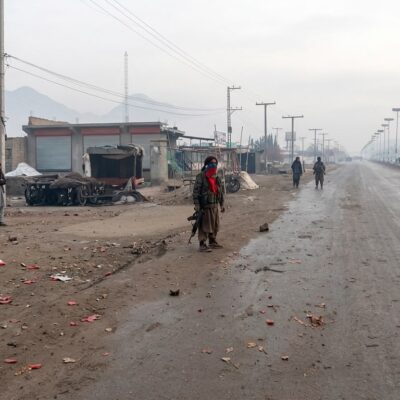
Indigenous peoples around the globe have been profoundly impacted by colonialism across all domains of their cultures, including their intangible cultural heritage. The Nagas, Indigenous communities inhabiting parts of India and Myanmar, are no exception, having experienced a progressive Westernisation of their culture and performing arts since the mid-19th century.
This article examines how a rock band from Nagaland has sought to counter these developments by re-integrating aspects of traditional Naga music culture into their style. Based on an interview conducted in Nagaland in February 2025 with the two core members of the band ‘Abiogenesis’, it retraces the musical trajectory of the band, outlining its reorientation from a mimesis of Western rock music towards a re-embracement of Indigenous Naga performing arts.
The Nagas
The Nagas are a cluster of culturally related yet distinct Indigenous peoples inhabiting the foothills of the Eastern Himalayas in parts of Northeast India and northern Myanmar. They likely migrated into this region centuries ago, with some sources suggesting Southwest China as a possible area of origin. Today, Indian authorities officially recognise 17 Indigenous communities as inhabitants of the state, 15 of which are considered as Naga. There are further Naga communities in the neighbouring Indian states of Arunachal Pradesh, Assam, and Manipur, and in the Sagaing Region and Kachin State in northern Myanmar.
Their languages belong to the Tibeto-Burman language family, and each community speaks its own language, in some cases several languages, most of which are mutually unintelligible. The creole language Nagamese is used for intercommunal communication, while Hindi and English are used for conversing with non-Naga Indians and foreigners. Traditional systems of Naga belief are animist but usually include a concept of a supreme spirit. Notorious for their head-hunting traditions, the Nagas were once feared for their attacks on surrounding settlements, including villages inhabited by other Naga communities.
The impact of colonialism
The colonial period brought profound changes to Naga ways of life. The British entered western Nagaland in 1832, attempting to establish a route of passage from colonial Manipur to Assam. In the following decades, they gradually expanded control over Naga-inhabited regions, establishing the Naga Hills district in 1866 that grew eastwards in the following decades, as further Naga territories were annexed in a series of violent conquests. The first religious conversions occurred in 1872, when an American Baptist missionary converted nine Ao Nagas (a major ethnic group) to the Christian faith. In the following decades and throughout the 20th century, Baptist priests and missionaries of other denominations spread Christianity among Naga communities to the extent that today, around 88 percent of Nagas in Nagaland are Christian and 75 percent in the Naga Self-Administered Zone in the Sagaing Region of northern Myanmar are also Christian.
Colonisation, proselytisation and Westernisation have had a profound imprint on Naga society and culture, including in the domain of performing arts. While traditional songs and dances are still performed in villages and at the annual Hornbill Festival, particularly in urban regions, traditional Naga performing arts have largely been replaced by a variety of imported and blended music genres, which are performed by artists and ensembles such as the Nagaland Conservatory of Music, the singer-songwriter Rewben Mashangva, the pop singer Temsu Clover, the rapper Moko Koza, the folk-fusion band ‘Tetseo Sisters’, the gospel band ‘Onou Ngühlang’, and the hard rock band ‘About Us’, to name a few.
The Naga band ‘Abiogenesis’
Moa Subong (b. 1960) and Arenla Subong (b. 1958) began making music together around 1978, when Arenla heard Moa’s band ‘Heavy Zap’, which performed on Saturdays in the town hall of Moa’s hometown Mokokchung, in northern Nagaland. According to Moa, the band’s style was influenced by the music that he and his friends heard on Rangoon Radio. Also, his uncle had a record shop from where he brought the latest LPs back home. When the couple started a family, they paused their musical activities due to time constraints. When their three children grew up, the couple continued their musical careers, performing cover songs as a duo, with Moa singing and playing the guitar and harmonica and Arenla as the lead singer. In 1989, they recorded their first album, titled ‘Rapture’, in a studio in Kolkata, accompanied by members of the Indian rock band ‘Shiva’. It caught the attention of music producers and was released by the Mumbai-based label Magnasound. In 1990, the duo toured in Kolkata and Nagaland, accompanied by ‘5th Dimension’, another Kolkata-based band.
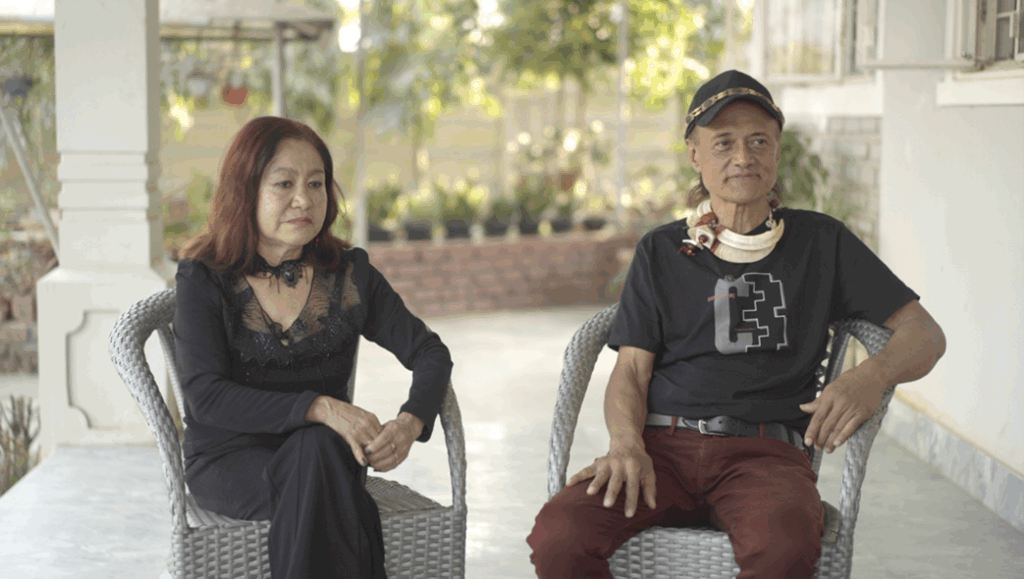
Arenla and Moa Subong at their home in Dimapur, 9 February 2025. Credit: Author.
Realising that working with a regular group of musicians from Nagaland would be more effective than with various bands from outside the state, Moa and Arenla eventually founded their own band in 1991 and chose the name ‘Abiogenesis’ with the literal meaning ‘the emergence of living organisms from inanimate matter’. As Moa and Arenla explained during our interview in February 2025, many of their friends were addicted to hard drugs such as heroin and they wanted to bring them ‘back to life’ through music.
Nagaland is in proximity to the Golden Triangle, which has been one of the largest opium-producing areas in the world since the 1950s, expanding across northeastern Myanmar, northwestern Thailand, and northern Laos. Nagaland functions as a transit route for illegal drug trafficking, resulting in communities there accessing hard drugs. Studies suggest links between the ethnic and political insurgency aimed at Naga self-determination and drug abuse in Nagaland.
New Naga musical instruments
Both Moa and Arenla Subong belong to the Ao Naga community, which has a rich tradition of performing arts and oral traditions. Yet, the musical style of the band Abiogenesis was primarily oriented towards folk rock and other genres of Western popular music until the early 2000s. This began to change around 2004–2005, when Moa was searching for a suitable Naga musical instrument to accompany Arenla when she was appointed as a folk theatre and music teacher by the North East Zone Cultural Centre, an organisation dedicated to promoting the cultural traditions of Northeast India.
Frustrated by the limited tonal scope of traditional Naga melody instruments, Moa invented the bamhum, a membranophone with a buzzing sound that is fairly easy to learn. Inspired by Naga culture in materiality and design, the instrument is primarily made from bamboo, a natural resource contributing to Nagaland’s economy. Naga artisans provide Moa with the raw materials for manufacturing the instrument, which he sells. Made from a hollow bamboo tube with a burn design and a cotton rope wound on one side and an ornamental cloth on the other, its optics are inspired by traditional Naga material culture, of which bamboo artisanship and woven cloths with geometrical pattern designs are an integral part.
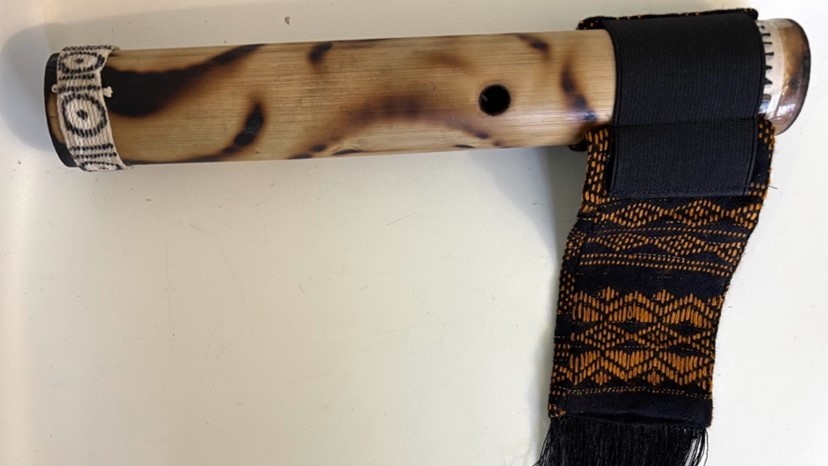
A bamhum. Credit: Author.
In May 2005, the then Governor of Meghalaya, Mundakkal Mathew Jacob, officially released the bamhum to the public at the International Bamboo Fest organised by North-Eastern Hill University in Shillong in collaboration with the Indira Gandhi National Centre for the Arts, an event that aimed to promote awareness about the preservation and cultivation of bamboo material culture and connected oral histories of Northeast India. The bamhum, which is played both by Moa and Arenla, sometimes in a duet, made its first musical appearance in the songs ‘Saramati Tears’ and ‘Misty Dzukou’, released on the album ‘Aeon Spell’ (2007). It also features prominently in the song ‘Whispering Mountains’ from the album ‘Rustic Relish’ (2008) and in the single ‘Zup Zup’ (2023), amongst others.
The emergence of a new genre of music: Howey
Significantly, ‘Aeon Spell’ was also the first album of the band on which lead singer Arenla integrated stylistic elements of traditional Naga singing in her vocal parts, marking the band’s departure from folk rock towards their newly invented music style howey, a blend of traditional Naga music with Western and Indian popular music. The term howey itself also relates to Naga culture, being derived from the vocal parts of traditional Naga songs and work chants. Through the years, the band changed its line-up several times, the number of involved musicians numbering in the dozens, with Moa and Arenla as its anchor.
In 2011, Moa invented the tikzik, a bamboo percussion instrument that looks similar to the bamhum but sounds very different. It was born out of an experience in 2011 when the Guwahati-based TV channel Northeast Television asked the band to perform for the recording of an ‘unplugged’ session in the open, where the drums drowned out everything else. Combining the functions of a scraper, rattle, and percussion tube in one, the tikzik is a versatile instrument capable of producing a variety of sounds.

A tikzik with scraper. Credit: Author.
The song ‘Voices in Kisama’ from the album ‘Legacy of the Mountains’ (2012) stands out, featuring both the bamhum and the tikzik. The song video shows the band performing on ornate instruments in stage outfits inspired by Naga culture against the backdrop of Kisama Heritage Village, the site of the Hornbill Festival that celebrates traditional and contemporary Naga performing arts. As such, the song video epitomises the band’s re-embracement of Naga traditional culture through the howey music style. Abiogenesis has gained huge popularity, particularly among the younger Naga generation, and paved the way for other fusion groups blending Naga and Western music styles such as the bands ‘Purple Fusion’ and ‘Featherheads’, founded in 2012 and 2016, respectively. But there have also been sceptical voices, as some have regarded Abiogenesis as straying too far from traditional Naga music and culture. Thus, late Ao Naga folk artist A. Bendangyanger Tsuwar Jamir criticised the band for mixing Western and Naga music styles and stage attires too freely. Criticisms like these reflect concerns particularly among the older generation over the progressing ‘Westernisation of Nagas’ and the ensuing loss of traditional culture.
As a result of Moa’s efforts to promote his inventions through the band’s musical outputs and connected efforts such as a TEDx Talk, the bamhum has gained popularity in Nagaland and beyond. The Tetseo Sisters, a popular folk-fusion group from Nagaland, used it in the song ‘La té! Vé té ho! (Stop! Enough!)’, a joint production with the Mumbai-based hip-hop producer Bluesanova. Other artists have adopted the bamhum as well, such as the Ao Naga singers Nungshitula and Merenyangla Pongener, an Ao Naga folklore group from the village of Ungma, and even the Delhi-based Indian fusion rock band Parikrama, illustrating the instrument’s success beyond Nagaland.
National awards and international outreach
In 2023, the President of India awarded Moa a Padma Shri, the fourth-highest civilian award in India, for the category of art. Notably, the only other Naga musician to have received a Padma Shri is the singer-songwriter Rewben Mashangva from Manipur of the Tangkul Naga community, who received the award in 2021. In recognition of his invention of the bamhum, Moa has also received an award from the National Innovation Foundation India in 2017.
These official honours for Naga artists are part of the cultural policies of the current BJP-led Government of India, which seeks to promote the tangible and intangible cultural heritage of the country’s ethnic minorities from the Northeast, thereby furthering their cultural integration and supporting the economies of the northeastern states, which have been affected by various ethnonationalist insurgencies since Indian independence. State-sponsored cultural events, such as the annual Hornbill Festival of Nagaland that attracts many Indian and foreign tourists every year, are part of this policy of cultural exchange and integration, which seeks to counteract sentiments of alienation caused by the racial discrimination of northeastern ethnic minorities and weaken support for separatist factions arising from economic neglect and social disadvantage.
Engagement with social and global concerns
The career of the band Abiogenesis has also been characterised by various forms of social and environmental engagement that reflect their understanding of their roles and responsibilities as artists. In 2002, the band collaborated with the Nagaland State AIDS Control Society and in 2004 with Nagaland’s Department of Health and Family Welfare, who asked the band to support health awareness programmes through their music. More recently, the band linked their song ‘Let’s Do Something’, which thematises the global climate crisis, to the website of the US-based NGO Sea Us Rise, which seeks to support climate action by promoting environmental protest songs.
In sum, the band’s musical trajectory illustrates the resilience and adaptability of Naga culture, which has faced a continuous onslaught of Western influences over the past 150 years that has had a profound effect on Naga ways of life. This constant renewal has been part of the histories of Indigenous cultures around the globe, whose cultures have often been portrayed as stagnant and destined to die out, a colonial stereotype that is still common in Western societies today. Moa’s innovative musical instruments exemplify creativity, innovation, and an entrepreneurial spirit that seeks to unite tradition with modernity, while adapting to the reality of an increasingly commercialised Naga music industry. Lastly, and perhaps most significantly, the band’s social and environmental engagement illustrates their sense of being citizens not only of Nagaland but also of the world. It underscores their awareness of the weight that Indigenous engagement with ecological issues carries in environmental discourses today. The band’s artistic path thus illustrates the artistic and professional fulfilment that Indigenous artists can hope to achieve when they reconnect with their traditional identities, cultures, and epistemologies, which carry more meaning than ever.
Main image: Arenla and Moa Subong performing as ‘Abiogenesis’. Used with permission from Moa Subong.