Following the transformation of Syrian statelessness during the civil war (2011-2024) recent regime change is bringing new, sometimes controversial, possible changes.
Key words: Statelessness, Syria, Nationality Law, gender discrimination, Palestinians, Kurds.
Since the fall of the regime led by Bashar al-Assad in Syria during December 2024, previously unimaginable—and sometimes controversial—openings have emerged to address historic statelessness problems in the country.
This article is based on my recently-completed doctoral research about statelessness in Syria, which draws on remote and in-person interviews with key Syrian and international stakeholders. In addition, I have visited Syria multiple times over the last year to engage with the MENA Statelessness Network (Hawiati) supported by the Global Campaign on Equal Nationality Rights on the problem of gender discrimination within Syria’s Nationality Law that can lead to statelessness.
Syrian statelessness before the civil war (2011-2024)
Syria has long experienced significant, often multi-generational, situations of statelessness (people holding no Syrian or any other citizenship), mainly relating to Palestinian refugees displaced to Syria since 1948 and a section of the country’s Kurds since 1962. A 1962 Census resulted in approximately 120,000 Syrian Kurds, 20 percent of the Syrian Kurdish population, being stripped of their citizenship. In 2011, there were an estimated half million Palestinian refugees in the country lacking any formal citizenship status, and some 300,000 stateless Kurds.
In addition, gender discrimination in the Nationality Law (No. 276 of 1969) restricts Syrian mothers’ ability to pass on citizenship to their children, placing them at risk of statelessness. Citizenship is primarily passed to children via their fathers, leading to problematic situations when paternity cannot be established. There had been scarce legislative change to Syria’s nationality regime throughout the rule of the two Assads (Hafez from 1970 to 2000, and his son Bashar from 2000 to 2024).
Syrian Statelessness after 2011
In 2011, Syrians joined the Arab Spring protest movement which marked the start of the subsequent 14-year civil war and constituted a critical juncture for meanings and experiences of Syrian statelessness.
In April 2011, Bashar al-Assad issued a Presidential Decree (No. 49), which ‘granted’ Syrian citizenship to one section of the stateless Kurds—those registered as ‘foreigners of Hasakah [governorate]’. By mid-2013, over 100,000 stateless Kurds were reported to have accessed citizenship through the Decree’s provisions. However, a second category of stateless Kurds—namely the maktumeen—were not mentioned. In general, the Decree was perceived as a measure to distance Syria’s historically restive Kurdish community from participating in the dissent of the Syrian Revolution that was otherwise sweeping across the country. As such, many Kurds were suspicious of the government’s motivations and ultimately critical of a gesture that was not accompanied by any acknowledgement of the historic deprivation their statelessness represented. Human rights groups such as Syrians for Truth & Justice continued to advocate on both the practical barriers still faced by many maktumeen and the need for historical reckoning for Kurdish statelessness.
No initiative similar to Decree 49 was taken to address the gender discrimination in Syria’s Nationality Law, presumably because children born to Syrian mothers were not a demographic constituency that presented any significant political threat to the ruling regime.
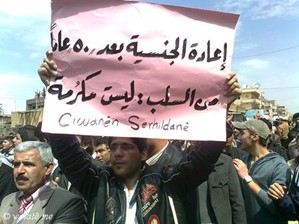
Kurdish protest in Qamishli, April 2011. Banner reads ‘Returning Nationality After 50 Years of Deprivation is not a Gesture of Generosity’. Source: Welatê me, reproduced with permission.
At the same time, the civil war, as a colleague and I have argued elsewhere, ‘brought about additional risks and instances of becoming stateless [and] transformed situations and vulnerabilities for those who already lacked Syrian citizenship.’ Many stateless Syrians were displaced to new geographic contexts, including to those far beyond Syria’s borders where their statelessness often took on new dimensions under strikingly different legal and bureaucratic contexts. For instance, in Syria itself it had not been possible to present statelessness for consideration of the courts because they lacked jurisdiction to hear matters about nationality and statelessness. Matters relating to nationality acquisition/loss are under the discretion of the Minister of Interior. But stateless Syrians who reached Europe sometimes found that their statelessness could be brought before a court.
More than a decade of conflict-induced displacement and the patchwork of non-state actors controlling and governing territory has meant that many Syrians do not hold recognised national documents. The questionable status and validity of documents issued by bodies affiliated with various parties to the conflict potentially leaves many Syrians (especially children born in such territories) lacking legal identity and at risk of statelessness. Within this context, children born to foreign fighters may face particular challenges due to the security sensitivities surrounding their father’s identity. Finally, Syrians whose essential documentation has been lost or destroyed due to the conflict and/or displacement may find it difficult to prove their Syrian nationality. These challenges have been ‘inherited’ by the non-state actors, primarily Hay’aat Tahrir al-Sham (HTS) that had been controlling territories in the Northwest Idleb region of Syria, as they suddenly shot to national governance prominence after the fall of the Assad regime.
New risks of statelessness after the 2024 fall of the Assad regime
The post-Assad context, since the former President’s sudden and unexpected fall in late 2024, has ushered in a series of further, sometimes quite radical, new developments regarding statelessness.
A civil documentation crisis emerged, mainly in the immediate aftermath of the fall of the regime, resulting from the suspension of the Directorate of Civil Affairs in registering new life events and issuing personal identity cards. Consequently, many marriages and births were not officially registered, leading to legal ambiguity and the risk of childhood statelessness. The Immigration and Passport Office building in Syria’s capital Damascus was destroyed in a fire, reportedly caused by an Israeli airstrike the same day that Assad fled the country, leading to challenges in preserving Syrians’ rights to legal identity. While services for updating civil status records officially resumed on 30 June 2025, populations in wide swathes of territories in the country’s north east remained cut off from civil registry services for far longer. Additionally, many returning refugees have struggled to register their children born outside Syria due to missing documentation, unclear procedures, and financial hurdles. Lack of proof of paternal descent places them at risk of statelessness due to persistent gender discrimination in Syria’s Nationality Law.
Navigating the challenges of re-establishing a fully integrated and functional civil registry system for the whole country following years of territorial division and parallel sub-national operations, the newly empowered provisional authorities led by Hay’aat Tahrir al-Sham in Damascus have also contemplated a number of parallel actions that have implications for statelessness in the country. While sometimes radical initiatives to address statelessness issues have been implemented, these actions have not been without controversy. It is important, therefore, to consider the impacts on, and reactions of, those most directly affected by such measures.
Current controversies
Since the fall of the Assad regime, reports and rumours around changes to the classification of citizenship and civil registration status for various profiles of people have proved controversial. Such issues range from the revocation of citizenship from foreigners purportedly naturalised due to loyalty to the Assad regime, to proposals around the naturalisation of foreign fighters (in recognition of ‘distinguished services to the state’), and the ‘erroneous’ re-classification of Palestinian refugees as ‘foreigners’. Additionally, reports about new arrangements for the printing of official documents in Turkey resulted in concerns about Syria losing sovereignty and independence within such processes. All of these instances show how issues around legal identity open the thorny topic of delineating between Syrian citizens and non-citizens, and the associated demographic questions: Ultimately who is, or should be, considered as Syrian in the present context? And critically, what about those rendered stateless (newly or otherwise) in the process?
Major recent developments in relation to Kurdish statelessness
In its first full year in power, the Syrian provisional government failed to build confidence with the Kurdish community through good-faith recognition of Kurdish linguistic and cultural rights as well as the statelessness legacy.
In September 2025, a new Network of Statelessness Victims in al-Hasakah was formed by affected individuals to advocate for ‘recognition, reparation, institutional reform, and guarantees of non-recurrence […] in response to the painful reality of hundreds of thousands of people—mostly Kurds—being stripped of their right to citizenship under the 1962 Census.’ As part of a research trip to Syria in December 2025, I had the opportunity to organise a workshop with the Network’s members to discuss the connections between Kurdish statelessness and gender discrimination in Syria’s Nationality Law. Within this context, participants expressed commitment to intersectional rights recognition: for Syrian mothers to be able to transfer of their nationality to their children; and redress for sections of the Kurdish community who have experienced multi-generational statelessness. Participants in the workshop also lamented that the limited mandate of the National Commission for Transitional Justice established in mid-2025 to focus on ‘grave violations caused by the former regime’ (in place from 1970) may effectively exclude the outcomes of the 1962 Census.
Marking a strikingly new direction, in January 2026 Syria’s President Ahmad al-Sharaa issued a Decree (No. 13) recognising Kurdish cultural rights and ‘[cancelling] all exceptional laws and measures resulting from the 1962 Census in Al‑Hasakah province [and] granting Syrian citizenship to all residents of Kurdish origin living in Syria, including those previously unregistered (the maktumeen), with full equality in rights and duties’ (Article. 4). While such an affirmation of Kurdish citizenship rights in Syria is historically unprecedented, the context of the Decree has left many Kurds feeling conflicted. Reception of the Decree was significantly shaped by the fact that it was issued between two military campaigns by the Syrian Government targeting Kurdish-majority territories (in Aleppo city first, and then in the Northeast and Kobani). This ultimately gave the impression that the government considers Kurdish rights of tactical political value, rather than being innate and unconditional.
A statement by the above-mentioned Network notes that the Decree’s ‘wording remains insufficient to address the structural and systemic roots of statelessness in al-Hasakah,’ adding that ‘events of 1962 did not constitute an administrative mistake, but rather a deliberate and systematic violation of a fundamental human right.’ They thus take issue with the term ‘granting’, calling instead for ‘restoration of Syrian nationality to its rightful holders who were unjustly deprived of it.’ For others, the move is reminiscent of the bad faith ‘deception’ practised by Assad in his 2011 Presidential Decree mentioned above. While Decree No 13 is unprecedented in Syria’s history, it remains to be seen whether it will translate into meaningful efforts to address the comprehensive legacy of deprivation that resulted from Kurdish statelessness.
Future prospects
Just as Syria’s Arab Spring moment in 2011—like elsewhere in the Middle East—served as a critical juncture for statelessness, the fall of the Assad regime in late 2024 has signalled significant new developments. The case of Syria thus highlights how the fate of the various profiles affected by statelessness can evolve in different directions during times of political transition.
The true test of the current authorities will be in drafting a new Constitution and Nationality Law that both incorporate a genuine recognition of Kurdish statelessness (and commitment to comprehensively address it) alongside explicit gender equality regarding transfer and acquisition of Syrian citizenship. While the authorities may be incentivised to accommodate children born to Syrian mothers and ‘foreign (fighter)’ fathers among their core supporters, it is important that any such solution be based on comprehensive legislative reform rather than exceptional in nature. Removing gender discrimination in the Nationality Law could be an ‘easy win’ for a government seeking to build legitimacy internationally and at home.
In an unprecedented recent development, a conference held at Damascus University about addressing the present gaps, highlighted the risks of statelessness and other negative consequences. The strong media coverage of the event firmly put the issue on the national agenda. In parallel to the prospects to reform the Nationality Law (once the new Syrian Parliament is finally activated), there is also a need to ensure that Syria’s long-term legacy of statelessness is comprehensively addressed within a transitional justice framework. The gravity of these challenges is not to be overstated. However, if the right steps are taken, Syria could, as one Palestinian from Syria affected by statelessness has optimistically commented, ‘change, from one of the biggest statelessness exporters to a role model for the Global North.’
Image: Aerial view of buildings in Damascus. Photo by Yazan Ali/Pexels.