Since 1976, Campbell Macknight’s germinal book, The Voyage to Marege’: Macassan Trepangers in Northern Australia, has informed important research into the historical voyages of Indonesian boat fleets from Makassar in Sulawesi to harvest trepang (sea cucumber) from the shallow coastal waters of Arnhem Land in Australia’s Northern Territory during its commercial height between 1750 and 1907 CE. Today, the Indonesians who worked this industry are commonly remembered as Makassans due to their main port city of origin. While the Makassarese people were greatly involved in this historical trade, the use of this term in this context lacks specificity—the fleets that sailed to Australia from Sulawesi were both multi-ethnic and multi-lingual, comprising local Buginese, Makassarese, Butonese, Mandarese and Sama seafarers, as well as many others from further field. Despite this, little has been done to understand how their diversity may have shaped their exchanges with Indigenous peoples in Australia.
Similar diversity existed among the Indigenous Australian peoples who they met across the Kimberley region of Western Australia, the Top End of the Northern Territory and the Gulf of Carpentaria, which extends eastwards into northwest state of Queensland. The Kimberley was known to seafarers from Makassar as Kayu Jawa (Java Forest). However, the paucity of primary accounts and written records of this trade from other regions across Australia’s north, has meant that most research into Australian trade sites has focussed on Arnhem Land. Greater Arnhem Land, historically spanning the whole of the Northern Territory’s Top End coast, was known to seafarers from Makassar as Marege and local Indigenous peoples there still retain rich public ceremonial traditions, derivative artistic expressions and Indonesian loan-word vocabularies that memorialise and perpetuate the enduring legacy of their shared history.
Our work on connections beyond the trepang trade
This article brings together a diverse team of authors from Australia and Indonesia to expand understandings of the fuller multi-ethnic and multi-lingual dimensions of this historical trade. Drawing upon our own series of collaborative visits between Indonesia and Australia over 2023–2025 and supporting scholarly literature, we show how this rich and complex diversity remains evident in Indonesian loan words still spoken in Indigenous Australian languages, as well as enduring oral histories and ceremonial traditions in both Australia and Indonesia.
Our first collaborative visit from Australia to Indonesia was led by Prof. Brian Djaṉgirrawuy Gumbula-Garawirrtja, an Indigenous Knowledge Fellow at the University of Melbourne and a senior Yolŋu ceremonial leader of the Birrkili Gapupuyŋu group from Arnhem Land who held ancestral songs, dances and designs that recounted his people’s long historical ties with Makassar. His family had long celebrated their known descent from Makassan ancestors and, in 2023, he and his wife, Renelle Gandjitjiwuy Gondarra, visited Makassar for the first time with our team, leading to an extensive series of exchanges with colleagues from Makassar’s Universitas Hasanuddin and Universitas Negeri Makassar (UNM) in both Australia and Indonesia. Insights from our two most recent visits to Sulawesi, funded by a First Nations International Partnerships Grant from the Australian Department of Foreign Affairs and Trade in 2025, have greatly informed our approach to this article, as they enabled road trips to a more diverse array of pertinent sites elsewhere in South Sulawesi beyond Makassar, including the shipyards and Konjo communities of Bulukumba Regency to the east, and to the Mandarese homeland of our UNM co-author, Nurabdiansyah, north of Makassar in West Sulawesi. We also travelled from Makassar to the nearby island of Barrang Lompo, which has been an important maritime hub for centuries.
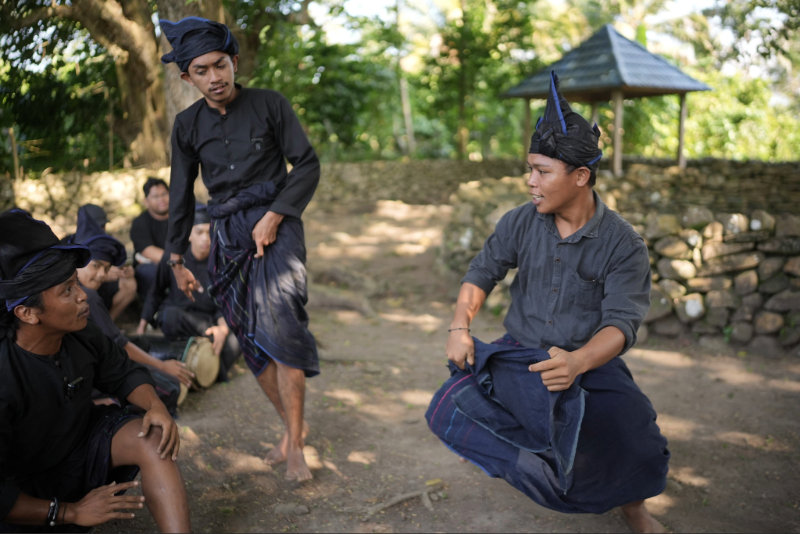
Traditional Konjo dancers performing, Tana Toa Kajang, Bulukumba Regency, July 2025. Used with permission from Agit Pramaswara.
Understanding the ethnic diversity of the Makassans
The Makassans of old did not share a singular ethnicity. Makassan, also spelt Macassan in English, is instead used as a generic term in this context to describe the seafarers from Indonesia who voyaged to Australia annually from at least 1750 until 1907, when the Government of South Australia, which administered the Northern Territory until 1911, ceased issuing them fishing licenses. The term ‘Makassan’ derives from the focal point of the trepang industry, the port city of Makassar in South Sulawesi, which had been the centre of the Makassarese Gowa–Talloq Sultanate since the 14th century CE, but came under the nominal control of the Vereenigde Oostindische Compagnie (VOC) in 1669, which was then nationalised as a Dutch Republic in 1800. Most ships used in this industry were various types of padewakang, a predecessor of the famous UNESCO-listed pinisi or Sulawesi schooner, which were predominantly built by Konjo people in today’s Bulukumba Regency. While histories of this trade have mainly focused on the harvesting of trepang from Arnhem Land, the Makassan seafarers also traded with Indigenous Australians for many other commodities, including turtle shell and various timbers in exchange for imported goods such as metal tools, cloth, rice, tobacco and alcohol.
The seafarers themselves were drawn from a multitude of ethnicities and spoke a multitude of languages. Being predominantly Muslim, some were likely of Arab ancestry. Buginese and Makassarese people from South Sulawesi, however, were likely the most prominent among their crews, due to the geographic centre of their industry in Makassar, with Butonese, Mandarese, Sama and other local people of the region also among their number. People from further afield, including those from Madura, Java, Borneo, Flores, Timor, Rote and Papua are also known to have worked on these vessels, as did Indigenous Australians on occasion.
It is to this broader grouping of East Indonesian, Timorese and Papuan people, who crewed the old trepang industry, that the term ‘Makassan’ has often been generically applied. Both Macknight’s book, The Voyage to Marege’, and Marshall Clark and Sally May’s edited book of 2013, Macassan History and Heritage, have nonetheless carefully warned against confusing these crews to be representative of a singular homogenous ethnicity. While we acknowledge the ethnic and linguistic complexities of the crew members of these fleets, for the sake of clarity we will refer to them under the umbrella term Makassan for the remainder of the article.
The geographical area of interaction extended way beyond Arnhem Land
Similarly confounding is that most available scholarship focussed on Australia concentrates on Arnhem Land, despite widespread evidence and historical accounts that Makassan vessels were also routinely present on islands off the Kimberley coast to the west and in the Gulf of Carpentaria to the east. Most literature nonetheless addresses the archaeological evidence found in Arnhem Land’s main interior cultural regions—the west, east and the Groote archipelago—and the high prevalence of loan words, public ceremonial traditions and derivative artistic expressions that show evidence of Yolŋu contact with these seafarers in northeast Arnhem Land.
It is well established that Yolŋu languages retain many loan words from those of the Makassarese and Buginese peoples, as well as Classical Malay, which was the lingua franca of sailors in Malaysia and Indonesia. Marcia Langton and Aaron Corn identify several loan words, including rrupiya (money), bandirra (flag), lipalipa (canoe), and baŋ’kulu (axe). Our intensive discussions have also revealed, however, that the reach of such loan words can also be heard in other parts of Australia, including areas where there was no documented contact with Makassans. Murri peoples from eastern Australia, for example, use the Malay word for milk, susu, to mean breasts, while in Torres Strait Kriol it also means sweet. Other Malay loan words in Torres Strait Kriol include kansa (blossom) and talinga (ear). Jill Vaughan and Debbie Loakes further note that Northern Territory Pidgin English, Broome Pearling Lugger Pidgin and a north Australia language that they refer to as ‘Macassan’ all contain Malay loan words. We also posited that Yokayi, an exclamation of victory and celebration used in Indigenous languages across southern Australia, could be derived from Ya, karaeng (Yes, lord) in the Makassarese language.
Interaction before the Makassans
It is also known that Makassans were not the first Southeast Asians to visit north Australia. Archaeological records show that sporadic Southeast Asian visitations to Australia may have occurred as early as 1000 CE. More regular voyages began sometime in the 16th and 17th centuries, which are notably evident in rock art in Arnhem Land that depicts Southeast Asian sailing vessels dated to 1517 at the earliest and 1664 at the latest. Yolŋu ceremonial traditions of northeast Arnhem Land have been influenced by other waves of pre-Makassan visitors who are thought to have arrived long before 1750. The first were a variety of different whale, turtle and dugong hunters, who are often described in Yolŋu tradition as having dark skin and are thought to have been various Sama and Malukan peoples, from what is now eastern Indonesia. Sama peoples have long dwelt primarily on boats and would later work on the Makassan fleets that annually voyaged to Australia after 1750. The Yolŋu elder, David Burrumarra, of the Warramiri clan recalled that these earliest visitors sailed from the northeast in dugout canoes and treated Yolŋu people as their equals. They were followers of Allah but, like the Yolŋu, also respected whale and octopus as sacred ancestors. Their camp in Arnhem Land, called Motatj, was in the Wessel Islands. They remain known to Yolŋu people today by various names, including the Bäpayili, Wurramala, Gelurru and Dhurrutjini. That latter name is cognate with Turijene, which is a Makassarese exonym for Sama peoples who settled in Sulawesi and Kalimantan in the 16th century and the islands of Lesser Sunda, Maluku and Raja Ampat.
A distinct wave of pre-Makassan visitors, called the Bayini, were said by Burrumarra to have golden skin. They did not harvest trepang, and instead built boats, made pottery, grew rice, dug wells and loomed cloth where they settled on the Warramiri homeland of Dholtji, where they worked for an ancestral spirit called Birrinydji and his wife, also called Bayini. Baine remains a common word in the Makassarese language for wife, while the cognate in the Buginese language is béné. These second-wave visitors generally respected Yolŋu people and participated in their ceremonies, yet kept their technological secrets to themselves, which led to conflict and their eventual departure.
Reflections and conclusions
While comparatively little is documented about the Kimberley, our University of Melbourne co-author, Nidala Barker, who is a Jabirr-Jabirr and Djugun woman from the Kimberley region, notes that oral histories of their presence persist in her family. She describes our time in Makassar as like stepping into a living continuation of her family’s history. In 2001, her parents— anthropologist Barbara Glowczewski and Aboriginal filmmaker Wayne Barker—worked in Arnhem Land in the Gumatj homeland of Bawaka with clan elder Murrmurrŋa Burarrwaŋa to record a documentary about the female ancestral figure from Makassar that watches over the homeland, also known as Bayini. This became the 2002 film Spirit of Anchor, which featured Murrmurrŋa and his family speaking about how historical relationships with Makassans had shaped contemporary Yolŋu culture. Twenty-four years later Nidala found herself in Makassar with Murrmurrŋa’s gäthu (son), our Yolŋu co-author David Yunupiŋu, watching that same film. He recognised himself on the screen and showed that footage to our co-author Abdi Karya from the University of Negeri Makassar. Abdi turned to Nidala and asked if her parents had made the film, and she realised that they had completed a circle of cultural continuity. They themselves were living proof that the connection between northern Australia and Makassar endures, which has sparked Nidala Barker’s own desire to cultivate future relationships into Sulawesi as a means of honouring the Kimberley’s own shared past with Makassar.
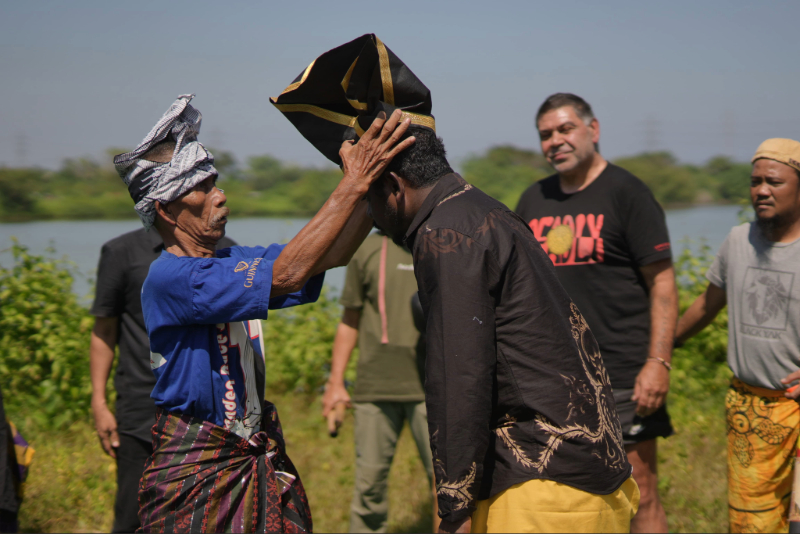
Renowned gendang musician Daeng Serang Dakko presents David Yunupiŋu with a patonro (headdress), Somba Opu, Gowa Regency, July 2025. Used with permission from Agit Pramaswara.
Our Yolŋu co-author, David Yunupiŋu, is descended from Buginese and Makassarese people through his mother. His grandfather’s grandfather was Using Daeng Rangka, pronounced Otjing in Yolŋu-matha, who captained the final ship that visited Arnhem Land in 1906–1907 and fathered children of Yolŋu ancestry. The Australian and Indonesian branches of their extended family have been reconnected several times since the 1980s and 1990s, including during our 2023 visit to Makassar led by Gumbula-Garawirrtja. During our most recent 2025 trip to Makassar, David was able to connect with Using’s descendants and visit his own ancestor’s graves there. He has since returned to Makassar to perform at the Makassar International Eight Festival and Forum 2025 and intends to go there again with his family to build further connections and perform ceremonies with his Indonesian relatives.
Overall, our team’s experiences through our shared exchanges in Australia and Indonesian have greatly expanded our understanding of the complexities of linguistic and ethnic diversity that existed among peoples at both ends during the height of the old trepang trade that will now guide our future research collaborations. We met boatbuilders in Tana Beru in Bulukumba Regency, who have modernised their pinisi-building tradition to produce larger, motorised timber vessels for tourism, while also endeavouring to preserve historical sailing techniques. We also met Konjo people in Bulukumba’s Kajang district, who consider themselves to be Indigenous in the Indonesian context and performed for us a traditional ceremony warning against the dangers of gambling on cockfighting that thematically and choreographically match ceremonial songs, dances and costuming still performed in Arnhem Land by Yolŋu people today to recount their historical trade with Makassar. On the island of Barrang Lompo, we met with local officials and contemporary trepangers who are directly continuing the same culture of shipping that once reached all the way to Australia’s northern coasts. All these stakeholders and many others in South and West Sulawesi are keen to engage with us in future research to find what new insights might be gleaned from previously unrecorded oral histories, cultural traditions, linguistic congruences and genealogies.
Authors: James Pilbrow, Nidala Barker, David Yunupiŋu, Abdi Karya, Nurabdiansyah, Dr Anthea Skinner, Prof Lisa Palmer & Prof Aaron Corn.
Main image: Abdi Karya, David Yunupiŋu and Guswan Gunawan, Tanah Beru, Bulukumba Regency, July 2025. Photo: James Pilbrow.