Professor Paelabang Danapan, also known by his Chinese name Sun Ta-chuan (孫大川), is a Taiwanese political figure, author, editor and academic.
A member of the Indigenous Puyuma people of Taiwan, Prof. Danapan has dedicated his life to preserving his community’s stories, traditions and identities, particularly through the power of Indigenous oral and written narratives. In 1993, he founded Taiwan Indigenous Voice Bimonthly (山海文化雜誌), the first publication in Taiwan dedicated to Indigenous literature and culture, and established the Shan Hai Literature Awards (山海文學獎) in 1995, the first literary prize for Indigenous writers in Taiwan.
In 2009, he was appointed Minister of the Council of Indigenous Peoples. He later served as Vice President of the Control Yuan (2014-2020) and Senior Adviser to the President (2021-2024).
The following is an adaptation of a presentation by Prof. Danapan at an event in Melbourne in May 2025, compiled as an interview by Cathy Harper and Samuel Curkpatrick.
Prof Danapan provided additional subsequent input and his words, originally in Chinese, have been translated by Lo Lee. (The Chinese version is available via this link.)
Can you tell us about the historical context of Indigenous peoples in Taiwan and the crucial role played by your family, especially your mother and great-grandmother, in passing traditional knowledge on to you?
Taiwanese Indigenous people didn’t used to have a writing system. We didn’t trust writing. Because of that, ever since I was little, I’ve been curious about the concept of writing.
In the past, memories and history were passed down in spoken, oral forms. Everything I know about my people, the Puyuma (卑南族), has been taught by my parents with speaking and with them telling me about the myth and the legend of my people, about the ritual and the ceremony, about all the songs we sing and the dance, and how we communicate, how we pass it down with our body and voice.
I was born in 1953, not long after World War II, and not long after the Japanese colonisation of Taiwan. As I was growing up, I could clearly feel that the oral history and the ritual and the ceremonies and our tradition were disappearing as more people moved to the city. Our community has been hollowed out and so has the inner world of our people. When I was young, I often wondered why our people had to experience such a fate.
To understand the context of Indigenous peoples in Taiwan, we need to look at historical maps. These maps often omitted or misrepresented Indigenous territories. For instance, Dutch colonial maps of Taiwan stopped at the Central Mountain Range, completely ignoring the eastern part where my people live.
Even during the Qing Dynasty in the 16th to 17th centuries, when many Han Chinese had migrated to Taiwan, Indigenous people were still not fully recognised on maps. It was only during the Japanese colonial period from 1895 to 1945 that more effort was put into mapping Indigenous territories, though we were still categorised differently.
During World War II, some of our people, including my uncle, fought for the Japanese in the Pacific War. Later, when the Republic of China (R.O.C., Taiwan) government came, others enlisted in the R.O.C. Army and fought in the Chinese Civil War. My cousin, now 93, was an intelligence agent in mainland China from the 1950s to 1990.
This is likely a common experience shared by Indigenous peoples globally. At times, it is unclear what the struggle is for. These experiences show how our people have been caught up in larger historical forces, often fighting in wars we didn’t fully understand and often ended up bearing the greatest harm.
Growing up in this context, I was always anxious about our culture disappearing. Until I was 33, I thought Indigenous cultures would vanish within my generation. I called this experience ‘sunsetting’.
Hope came from my family. My great-grandmother lived to be over 80 years old. The clothes she wore show the influence of Han Chinese culture, reflecting our complex history. My mother witnessed our culture and language disappearing as she lived to 107, but she made sure to pass it down to me. She speaks both Japanese, a remnant of the colonial period, and our Indigenous Puyuma language. When I talked with her, I had to speak Puyuma. Through it all, our families kept our culture alive. Thanks to these long-lived family members, our oral history and culture weren’t lost.
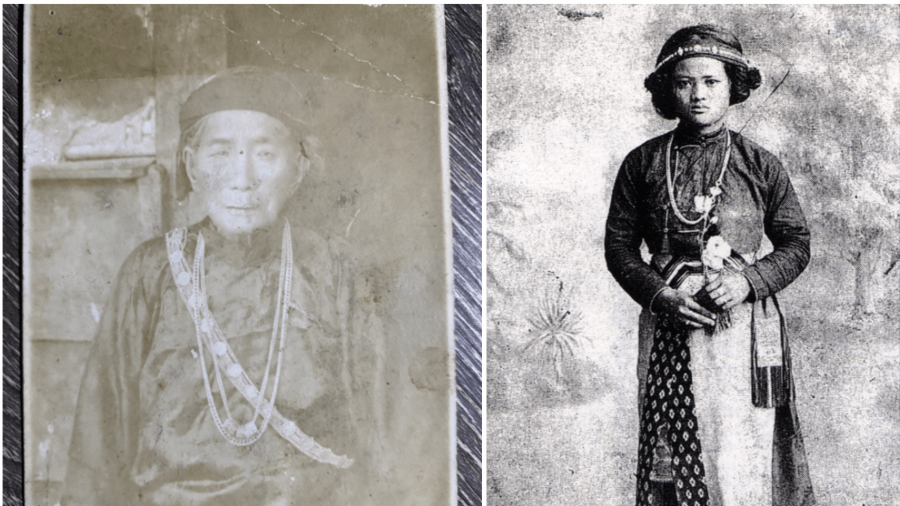
Left: Prof. Danapan’s great-grandmother, Taitung County, Taiwan. Right: Prof. Danapan’s mother, photographed in 1928, Taitung County, Taiwan. Images courtesy of Prof. Paelabang Danapan.
Your magazine ‘Taiwan Indigenous Voice Bimonthly’ was a significant platform for Indigenous writers. What inspired you to create this publication, and what impact do you think it had on Indigenous literature in Taiwan?
The oral histories passed down to me are among my most treasured memories. At the same time, I came to realise the power of writing, and I grew curious about it. I still remember opening my textbook in Year One and being astonished by the Chinese characters on the page. I was struck by how these characters could carry so much meaning and preserve so much memory. From that moment on, I became a lover of language and writing. Over the years, I have collected written materials from many sources and have also worked with a French priest to study ancient oracle bone scripts, the earliest known form of Chinese writing, originally inscribed on bones and turtle shells to record divinations and historical events.
In 1993, I launched the Taiwan Indigenous Voice Bimonthly. It ran until 2000 when we ran out of money. During its run, we accumulated many narratives and discussions by Indigenous people, especially those who couldn’t make their way into mainstream media. Our second issue focused on International Indigenous rights, coinciding with the United Nation’s Year of Indigenous Peoples. We translated the UN Declaration on the Rights of Indigenous Peoples. The magazine was a platform for Indigenous writers to publish and be heard. I always encouraged people to write, even if they weren’t confident in their writing skills. Writing makes our existence objectively present.
I also networked with mainstream media editors pushing them to publish Indigenous writers’ work. When our writers saw their articles in mainstream publications, they often cried with joy.
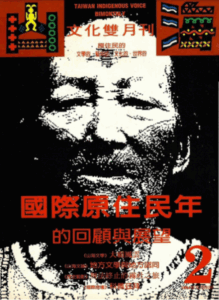
Cover of the second issue of Taiwan Indigenous Voice Bimonthly (January 1994). Used with permission from Taiwan Indigenous Voice Bimonthly.
You’ve been involved in collecting and documenting oral traditions, myths, and rituals, as well as restoring Indigenous ceremonies. Can you tell us about this work and its importance in preserving Indigenous culture?
We’ve put a lot of effort into restoring rituals and ceremonies. We want our writers to embody their culture, not just write about it. We want writers who can sing, dance, and live their culture. Now many of our rituals are very much alive. If you visit Taiwan, you can see the restored ceremonies of the Rukai, Tao, and Tsou peoples.
I’ve been documenting the rituals, ceremonies, and oral history of my own tribe. I translate and annotate them, thinking of future generations. Even if the next generation doesn’t appreciate it, in 500 years, it might be as valuable as ancient Chinese scripts are to us now. This work is crucial in preserving our culture and rewriting our history from an Indigenous perspective. It’s a way of defending our cultural identity against erasure and giving voice to Indigenous perspectives in mainstream discourse.
Since the founding of the magazine, what kind of development has Taiwanese Indigenous writing undergone?
When the magazine was first published, Taiwan’s Indigenous writing systems had not yet been standardised. Although we encouraged our people to use romanisation or any phonetic tools to write their Indigenous languages, Chinese writing was still the mainstream. I wasn’t worried though, because the Chinese that we write is quite different from the Chinese that Han people write. The way of expression, the inversion of grammar, even the symbolism and humour are all things you won’t find these in Han people’s writing.
Over the past ten to twenty years, Taiwan has done a lot of work revitalising Indigenous languages. In 2005, the government introduced standardised orthographies for these languages. This allowed us to include works written in Indigenous languages in our later literary collections.
We’re also working on making our literature accessible globally. We’ve been systematically working with Japanese translators to translate our Indigenous literature into Japanese. We have some translations in English and other languages too, but we’re still developing a more systematic approach for global outreach.
You have served in important political positions such as Minister of the Council of Indigenous Peoples and Senior Adviser to the President. Why have you emphasised literary creation, publishing, and education in advancing the Indigenous movement?
I felt that politics was the path of ‘to have’. It is necessary and important, but even more important is the path of ‘to be’. I believe the deepest value of Indigenous culture lies not only in ethnic identity or Indigenous rights. I very much hope that our future Indigenous movement will be one with ‘doors and windows’, an open stance that reaches toward the universe and toward the future. What I fear most is a movement that turns inward, becomes closed off, and is reduced entirely to political struggle.
To achieve a future with doors and windows, we need to have literature; once we have literature, there must be people researching it. Since returning to Taiwan, I have remained in university teaching while promoting the establishment of Indigenous literature courses. Our Indigenous literary works are also now largely included in secondary school language textbooks. Indigenous literature is not only something we create. There must also be people researching it, people reading it. Otherwise, all this work would be in vain.
What are you currently working on in terms of Indigenous cultural preservation, and how do international connections support this work?
International collaboration is crucial for our work. We’ve established connections with Indigenous groups across the Pacific region. In 2013, I established the Society of Pacific Studies, which now has over 30 members who have studied various aspects of Indigenous cultures in the South Pacific. I have also encouraged many Indigenous students to pursue further study in the South Pacific, with the hope that the Society will continue to grow and foster deeper exchanges with Austronesian peoples across the region.
These collaborations are particularly important for our language work. In recent years, my work has increasingly focused on encouraging the compilation of higher-quality Indigenous dictionaries. I have collected dictionaries from Malaysia, Indonesia, Palau, Fiji, and Māori communities in New Zealand, and through this comparative work I have found that many of our vocabularies are shared. These connections help us understand our ancient songs and reconstruct our languages.
I’m getting older now, and I don’t speak foreign languages well, so this international work will increasingly rely on the younger generations. What I can still do now is to use Puyuma people as a model to influence other tribes in reconstructing their classics. We have quite a few young people working with elders on much of this work, but we probably need a rigorous framework to ensure better quality in these efforts. We are also collecting and translating many handwritten manuscripts from the Japanese colonial period related to our rituals and ceremonies. This is the work we are continuing to do, while passing on to the next generation.
What significance or value do you think Indigenous culture has for contemporary society? What does Indigenous culture have to contribute?
I believe it is a calling to the ‘indigeneity’ within everyone. The core of Indigenous wisdom is about understanding our place in the universe and our connection to nature. As human beings, we often enclose ourselves within human society alone, forgetting that we are inherently part of the universe. The core of Indigenous culture, I believe, is to identify our shared roots and know that we belong to nature as a whole. This isn’t something I invented; Chinese Daoist thought has always discussed the same thing. We have simply forgotten it.
To me, the mindset of an Indigenous person is not that different from the mindset of a humble scientist. It’s just that one is writing about the universe through myth and legend, and the other is unpacking its mystery through research and theories.
I wish to live at least until I’m 107 years old like my mother! I want to visit Australia again when I’m 105. I am hoping to see Milky Way in Australia again. When I was little, every time I saw the Milky Way, I felt how profound the mysteries of the universe are and that we are merely a part of it.
This awareness has been lost and ignored among many Han people and other modern civilisations. Indigenous culture serves as a reminder to return to the indigeneity within each of us, to maintain humility before the mysteries of the universe.
Our work in preserving and promoting Indigenous culture is ongoing. It requires constant adaptation to new challenges and opportunities. But I’m optimistic about the future. With each generation, we find new ways to keep our culture alive and relevant, while staying true to our core values and connection to the land.
Prof. Danapan’s presentation in May 2025 was co-hosted by the Asian Cultural Research Hub and the Indigenous Knowledge Institute at the University of Melbourne, as part of the Taiwan Film Festival in Australia and supported by Taiwan’s Ministry of Culture.
With thanks to Associate Professor Craig Smith and Professor Fran Martin for hosting Paelabang Danapan at the University of Melbourne and convening his presentation.
Main image: Paelabang Danapan with students at the University of Melbourne, May 2025. Credit: Hymns Photography via Benson Wu, Taiwan Film Festival.
Further reading: