In April 2019, an Australian curator (a former colleague) was walking in downtown Zagreb, Croatia, when she glanced at a window display in a multinational fashion boutique. She immediately recognised a distinctive red-and-black pattern that she associated with the Oma ethnic group, having spent three years working on ethnic cultural heritage in Luang Prabang, Laos. Unsure whether this might be the result of a formal collaboration, she contacted us for clarification.
It became clear that the garments were not hand-stitched Oma textiles but printed imitations. There was no mention of the Oma on the labels, nor any acknowledgement of the designs’ origins. What might have appeared to other shoppers as simply a striking pattern was, to those familiar with the community, an unmistakeable appropriation using the same colours, compositions, and motifs.
The company denied any misappropriation. The clothing remained on sale and the company did not offer recognition or compensation. The community had virtually no recourse, as the designs did not fall under conventional intellectual property protections so there was no breach of law.
This incident highlighted how few protections existed for communities like the Oma. It illustrates both the fragility of traditional cultural expressions in a globalised fashion system and the difficulty of protecting them within current legal and commercial frameworks.
The Oma and their textiles
The Oma number less than 3,000 people living in seven villages in Phongsaly Province, a mountainous and isolated region of northern Laos. Their textiles are immediately recognisable: hand spun cotton, dyed a dark indigo, with bold bands of red and white appliqué and geometric embroidery. For the Oma, traditional clothing is not merely utilitarian but a crucial marker of cultural identity—a form of visual language that communicates belonging, continuity, and pride.
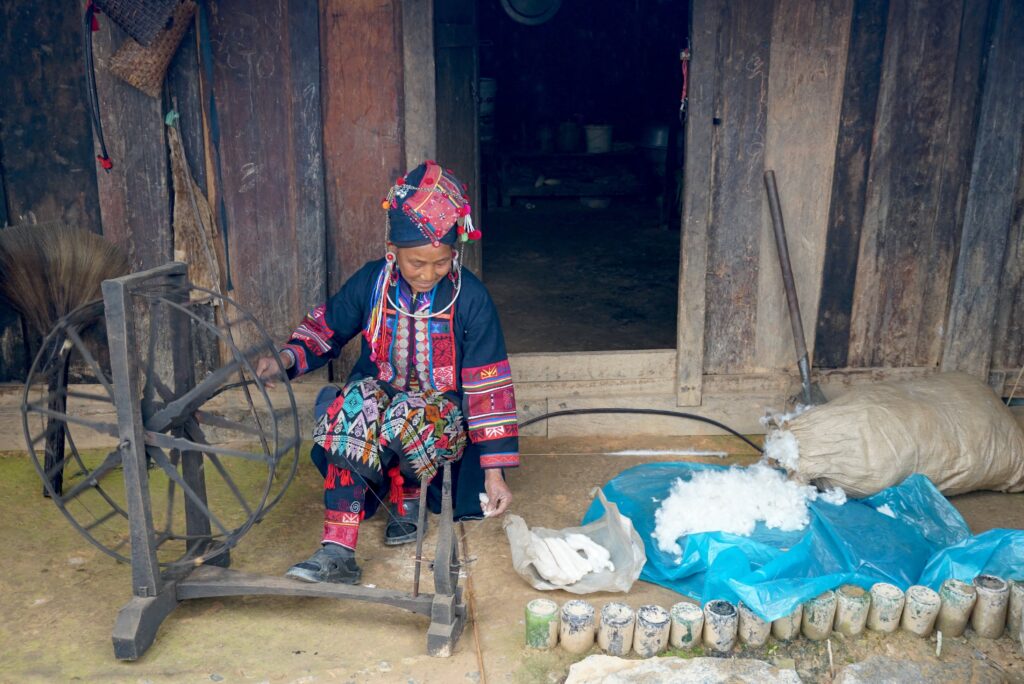
Oma spinning cotton. 6 January 2021. Used with permission from the Traditional Arts and Ethnology Centre, Laos.
Motifs hold meaning in both their form and placement. A chevron or spider, for example, becomes recognisably Oma when stitched in particular combinations and situated in specific locations on a garment. Headscarves, jackets, and leg wraps each carry visual cues that communicate belonging and pride. These textiles embody not just technical skill but social knowledge and familial ties, with designs passed from mother to daughter through years of apprenticeship and practice.
The traditional production process is meticulous. Cotton is grown, spun, and dyed by hand. Indigo dyeing involves cycles of preparation, fermentation, and dipping that require both technical expertise and environmental knowledge. Appliqué work—cutting, folding, and stitching narrow strips of cloth—demands patience and precision, as does embroidery, where stitches must be uniform and tightly executed to create the desired effect. Each garment can take many months, even years, to complete. The resulting textiles are therefore repositories of time, labour, and generations of knowledge.
Only one community continues to grow cotton regularly—others struggle with uneven rainfall, shifting seasons, and soil depletion. Many rely on cotton harvested and woven years earlier or purchase manufactured fabric from district towns. The traditional process of cultivating, spinning, and dyeing local cotton is both labour-intensive and ecologically sustainable, yet without recognition, investment, and fair compensation, few families can afford to maintain it. Faster and cheaper materials increasingly displace slower, more sustainable methods, subtly altering the texture and character of the textiles. This erosion reflects a wider tension: sustaining low-impact, community-based production requires systems that value time, skill, and ecological balance as much as efficiency and profit.
When removed from this context and reproduced as surface decoration through mass-printing, the significance of complex motif arrangements is eroded. They become anonymous design elements void of meaning, rather than expressions of identity and the role of the artisans who sustain the tradition is erased. For the Oma, as for many other communities, this paradigm compounds both economic marginalisation and cultural invisibility.
Cultural appropriation and its contemporary acceleration
Appropriation of cultural motifs in fashion is not new. In the early twentieth century, European designers freely drew on so-called ‘exotic’ influences. Paul Poiret’s ‘Orientalist’ collections reimagined Middle Eastern and Asian dress for Parisian elites. Yves Saint Laurent found inspiration in Moroccan caftans. The ‘peasant blouse’ entered mainstream Western wardrobes in the 1970s through stylised adaptations of Eastern European and Central Asian clothing.
What is new is the pace and scale at which such borrowing occurs. Global travel, digital photography, and social media allow motifs encountered in remote villages to be translated into commercial products within months. A designer or tourist can capture an image on a smartphone, which is then digitised, stylised, and printed on thousands of garments, distributed worldwide through global supply chains. What might once have been a modest, localised form of inspiration has become a mechanism of large-scale cultural and economic extraction.
At the same time, the language of ‘cultural appropriation’ has become both more widely recognised and more sensitive. It can encompass behaviours ranging from insensitive costumes to systematic commercial exploitation. Yet at its core, it describes a consistent dynamic: dominant groups taking symbols and knowledge from marginalised communities without consent, recognition, or reciprocity.
A multinational company could profit from designs cultivated over centuries within a legal system that does not recognise traditional motifs as ‘property’, involving small, rural communities which lack the means to contest their use. The disparity is stark: textiles that, when handmade, might be dismissed as ‘ethnic crafts’ and sold for a few dollars in a Southeast Asian night market, could become expensive luxury items when reproduced as prints and marketed under a designer label.
Systemic limitations of conventional intellectual property
The legal frameworks that govern intellectual property offer limited support for communities like the Oma, as they were designed primarily to promote business development: encouraging individual innovation and protecting commercial assets.
In Laos, copyright, designs, trademarks, and patents are available under the updated Law on Intellectual Property (Law No. 50/NA, 2023). In some cases, they can offer limited protection for derivations of traditional knowledge: an artisan’s interpretation of a traditional motif may qualify for copyright, and a new textile or craft pattern can sometimes be registered as an industrial design because the novelty requirement is modest. However, these systems are still costly, complex, and difficult for rural artisans to navigate, and they protect only the specific new expression – not the wider cultural tradition it draws from.
By contrast, Traditional Knowledge and Traditional Cultural Expressions are collectively held, transmitted through oral tradition and lived practice, and constantly evolving as each generation adapts them to new contexts. Precisely because they are communal, dynamic, and unfixed, they fall outside the boundaries of conventional Intellectual Property categories.
As a result, they are treated as part of the ‘public domain.’ Anyone may copy, adapt, or commercialise them without seeking permission. This framing reflects not only the limits of law but also a worldview that privileges the individual over the collective, written records over oral transmission, and industrial innovation over traditional practice. Despite decades of debate at the World Intellectual Property Organization (WIPO) no binding international Traditional Cultural Expressions framework exists. One recent achievement—the 2024 WIPO Treaty on Intellectual Property, Genetic Resources and Associated Traditional Knowledge—addresses disclosure obligations for genetic resources and associated Traditional Knowledge but does not extend to Traditional Cultural Expressions. Negotiations have faltered largely because of disagreement between states over how to define ownership, consent, and benefit-sharing, leaving national and community-level experiments to fill the gap.
The implications are significant. When designs are deemed public domain, communities lose not only economic opportunities but also recognition of their role as contemporary knowledge holders. Their creativity is rendered invisible, and their heritage is recast as a freely available resource.
Negotiating ownership and protection
It is tempting to respond to cases of misappropriation by calling for stronger legal rights for traditional designs. Yet this shift is not without its challenges. By their very nature, traditional cultural expressions are shared, flexible, and fluid. Motifs may cross regions and ethnic groups, taking on different meanings in different contexts. Individual artisans exercise creativity within frameworks of inherited rules, adding nuance while maintaining continuity.
Fixing such designs into databases, registries, or legal protections risks freezing them in time unless regularly updated. It can impose rigid boundaries where historically there was adaptation and exchange. Further, transforming cultural expressions into property may prioritise their commercial value above other dimensions—spiritual, social, or symbolic. Within communities, it can also generate tensions over who has authority to represent the group, and who should benefit from protection or partnership.
In the wake of the 2019 incident, Traditional Arts and Ethnology Centre in Laos and the Cultural Intellectual Property Rights Initiative® worked with the Oma to explore ways of navigating these tensions. Together, they developed a digital design database documenting motifs, meanings, and techniques, and an update is in progress. This approach is not perfect—it inevitably introduces a degree of formalisation—but it provides a practical tool for asserting authorship, educating collaborators, and establishing evidence of community-held knowledge. Ongoing community involvement is needed to ensure that the database remains a living record rather than a fixed archive, allowing designs to evolve while still offering a measure of protection. This initiative is part of a sui generis approach: a system tailored specifically to traditional cultural expressions, acknowledging that they cannot be adequately addressed by existing intellectual property frameworks. The initiative has since been endorsed by the Lao Department of Intellectual Property and the Lao Handicraft Association, signalling an important precedent in the region.
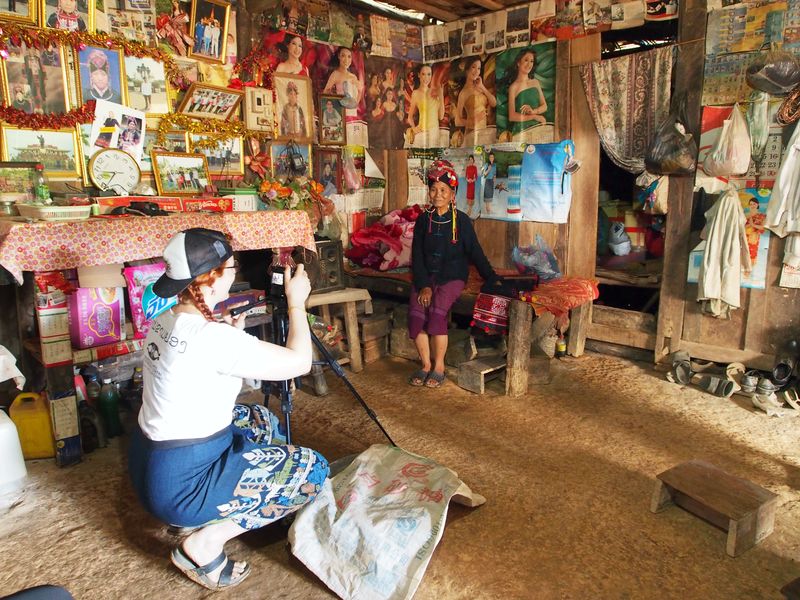
Documenting Oma and headdress. 5 January 2021. Used with permission of the Traditional Arts and Ethnology Centre, Laos.
The database serves multiple purposes. Defensively, it provides a record that can deter misappropriation, establishing evidence that these motifs are the heritage of a living community. Proactively, it affirms the Oma’s custodianship and offers a practical basis for fair collaborations with designers, researchers, and other external actors. Crucially, it is not intended to lock designs away or to reduce them to static assets. Instead, it is conceived as a living record, created with the participation of community members, recognising both the heritage and contemporary value of their work.
By documenting motifs in ways that highlight their meanings and techniques, the database also shifts the narrative. It shows that designs are not arbitrary decorations but embodiments of knowledge and collective identity. In doing so, it reframes cultural heritage for outsiders, making visible why unacknowledged appropriation is not a neutral act but one with cultural, social, and economic consequences.
Creativity, collaboration and caution
The goal is not to prevent cultural exchange. Cross-cultural influence has always been part of human creativity, and traditions themselves evolve through encounters and adaptation. The question is how to structure these exchanges in ways that are respectful and reciprocal.
Examples of ethical collaborations exist. Some designers work directly with artisans, creating collections that sustain traditions and generate income. Companies such as Filip + Inna and Nata y Limon have demonstrated that fair collaboration can enrich design while sustaining livelihoods. However, many designers and companies lack the infrastructure for such work. Slow, relationship-based production sits uneasily with seasonal fashion cycles, profit margins, and the communication required across languages and cultural expectations. Addressing these barriers requires rethinking not only ethics but the economics and timelines that define contemporary fashion.
Yet caution is necessary. As noted earlier, shifting traditional knowledge into systems of property and commerce can have unintended consequences. Protecting Traditional Cultural Expressions must not mean turning culture into a frozen resource or reducing it solely to an economic asset. Instead, it must seek to prioritise community agency, recognising that cultural expressions are simultaneously heritage, identity, and a living practice.
Towards systemic change
While new legal tools and sui generis frameworks are helpful, systemic change also requires broader shifts in attitude.
In fashion education, students are still encouraged to travel widely, gather ‘inspiration,’ and reinterpret motifs without being asked to question the ethics of this practice. In the fashion industry, the drive for rapid production and profit discourages time-intensive collaboration with artisans. Consumers, meanwhile, often see designs only as surface patterns, detached from their cultural meaning.
To transform these dynamics requires seeing traditional designs not as free resources to be borrowed at will, but as forms of living heritage. This involves changing how designers are trained, how companies are held accountable, and how consumers understand the cultural value of the products they purchase.
Governments must integrate the protection of Traditional Cultural Expressions into national legislation and provide resources for community-led initiatives. International organisations, including the World Intellectual Property Organization, must accelerate progress on frameworks that recognise collective custodianship. Industry associations must establish and enforce ethical standards. And consumers must be engaged not only as buyers but as participants in shaping accountability.
Systemic change also requires addressing deeper assumptions. As long as creativity continues to be defined in terms of individual originality and market value, collective traditions will remain marginalised. Recognising traditional cultural expressions as creative works in their own right—not as raw material for innovation, but as refined systems of knowledge, aesthetics, and meaning—challenges this paradigm. It affirms that such heritage is not peripheral to creativity but central to it: a living reservoir of imagination and skill that deserves to be valued, protected, and celebrated on its own terms.
Conclusion
The garments displayed in a Zagreb boutique in 2019 were more than printed patterns. To the Oma, they represented cultural identity, knowledge, and continuity. Their misappropriation illustrates the vulnerability of traditional cultural expressions in global commerce. Protecting such designs will always be complex, requiring a balance between preservation and adaptation, communal rights and individual expression, heritage and commerce.
These complexities, however, should not serve as an excuse for inaction. Rather, they highlight the need for careful, context-sensitive approaches that respect both cultural identity and creative freedom. Yet in a world that privileges industrial innovation and commercial assets over traditional knowledge, the burden of protection has so far fallen disproportionately on custodians themselves.
While granting full property status to Traditional Cultural Expressions can create new risks, community-led databases offer a practical form of interim protection, helping assert authorship. Meaningful protection will likely require a mix of such defensive tools and flexible, community-driven approaches that allow cultural expressions to remain dynamic.
The way forward lies not in closing off inspiration, but in reframing how it is shared. By embedding respect, reciprocity, and responsibility into the structures that govern design, commerce, and culture, we can shift from unacknowledged appropriation to genuine collaboration—from merely claiming inspiration to truly sharing it.
Main image: Oma creating traditional clothing. 5 January 2021. Used with permission of the Traditional Arts and Ethnology Centre, Laos.